

Laguna Society
A rescue centre for exotic animals
“We offer them a second chance, when fate took away the first.”
They come to us for all sorts of reasons: the pet grew into an adult parrot nobody could handle any more, the owner died, the animal was an unwanted gift, someone in the family turned out to be allergic. Some arrived injured or out of unsuitable conditions. Here are their records and their stories, as daily care writes them.
- 144
- animals in our care
- 82
- still without an adoptive parent
- CZK 0
- in public subsidies — we live on gifts and adoptions
How helping works
Before we ask anyone for money, we want it clear what the money buys. Contributions go to food, veterinary care and running the aviaries. Our accounts are kept on a transparent bank account that anyone can look into at any time.
Buy an animal lunch
A one-off contribution to one animal you pick yourself. No commitment, nothing recurring — you simply pay for its food once.
Virtual adoption
You become the adoptive parent of one animal and support it every month towards food and veterinary care. Write to adopce@centrumlaguna.cz with the animal’s name and your contact details; we will send you the particulars and, once the adoption is set up, the certificate. The amount and the standing order stay in your hands — you can cancel it any time, without us.
- an adoption certificate
- your name next to the animal on Laguna's website
- free entry to the shows Laguna organises
- you may visit your animal and follow how it is doing
- an invitation to Laguna's public events
- a donation receipt for your tax return, on request
The adoption is virtual: the animal stays in Laguna's care and does not go home with you. As an adoptive parent you join its “zoo family” and are welcome to visit.
Waiting the longest
No adoptive parent has come forward for these animals, even though they have been with us for years. They get the same care as everyone else — it is just that nobody knows about them yet.
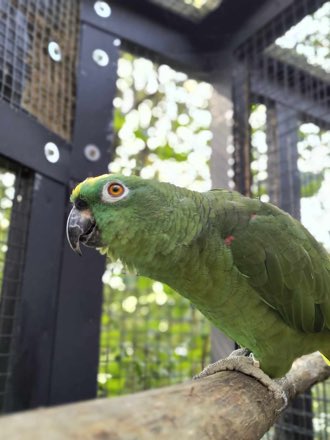
in our care since 2018 · 8 years
Wendy
Natterer's amazon Amazona ochrocephala nattereri
Wendy was originally an unsuitable wedding present. The newlyweds kept him for about half a year, but then they passed him on. A kind woman took him in and gave him a great deal of…
Buy Wendy lunchShow in the list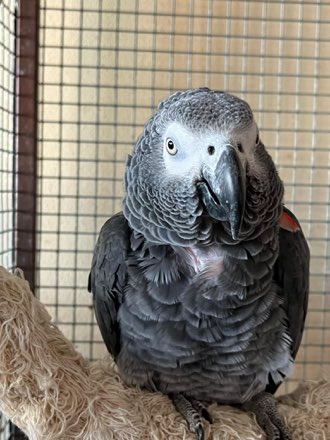
in our care since 2019 · 7 years
Pipi-Kuba
Grey parrot Psittacus erithacus
Buy Pipi-Kuba lunchShow in the listAll our animals
Cockatoos 31

Pepík
Citron-crested cockatoo Cacatua sulphurea citrinocristata
1 adoptive parentRead the story
The owner got the parrot Pepíček years ago as a beloved companion. They lived together well for many years. But then the man found a mate of his own kind and started a family. The new lady of the house tried to get on with Pepíček as well as she could, but Pepíček was jealous all the same. Still, everybody was fond of him, so they coped with a few minor attacks without any trouble. The trouble started when children were born into the family. And one day there was an accident — the little girl put her hand into the cage and Pepíček bit off a piece of her finger. Thanks to quick first aid and then a successful operation at the hospital, the finger was sewn back on and saved. All the same, the girl was left with a scar and a partly bruised finger. When the second child started walking too, the risk of injury rose again, and with a heavy heart the family gave the parrot up for the children's safety and placed him at Laguna.
My adoptive parents Šurýnová Pavla (since 7/2022)
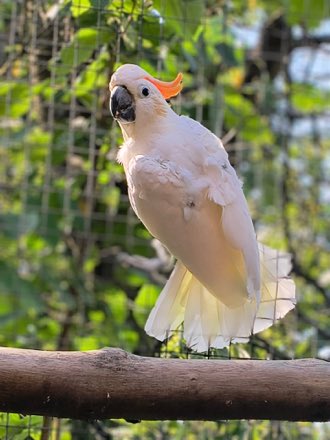
Singa
Citron-crested cockatoo Cacatua sulphurea citrinocristata
Looking for an adoptive parentWe have not written down a story yet.
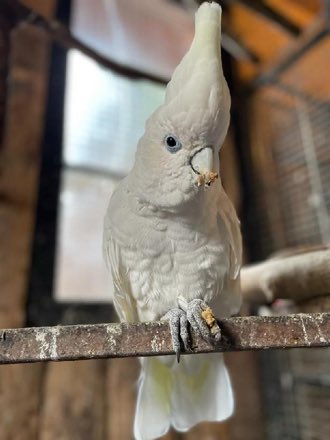
Kadu
Ducorps's cockatoo Cacatua ducorpsii
1 adoptive parent- Born
- 2003
- In care since
- 2022
- Location
- Luka pod Medníkem
Read the story
Kadu the Ducorps's cockatoo was originally an unwanted gift for a 17-year-old young woman, who did not want a parrot at all and did not want him. So the father took the cockatoo to his restaurant, where Kadu spent long years in the company of people, which suited him quite well. That ended the moment the restaurant closed down. So the cockatoo moved back home, but he was not content there; he missed company. In the end he wound up in a public place again — a café, where he lived for 1.5 years. He flew freely there and enjoyed the company of the customers, children included. Sadly that café closed down too and Kadu moved home again. He did not like that and made it known very loudly. So the owners decided to take the parrot to Laguna, so that he could find friends and be content at last. Kadu was first placed in quarantine in a home setting. He turned out to be a very perceptive, friendly and sociable parrot. He is now trying out life in the shared aviary of the gentler parrots. He flies with the group of amazons and other smaller cockatoos.
My adoptive parents Vodárek Pavel (since 2/2023)

Pepíček
Galah Eolophus roseicapilla
1 adoptive parent- Location
- Luka pod Medníkem
Read the story
They brought us a handsome fellow, a pink-and-white gentleman of elegance. He is Pepíček, a galah. He did not have an easy life either. True, he hatched to parents who looked after him in the nest box, but then it went wrong — they shoved him into a shop and soon sold him to a breeder for an aviary. He lived there for about six years, but apparently he did not distinguish himself much as a breeding male (goodness, whatever you do, don't tell him, we don't want him getting a complex), so the breeder sold him to his last owner. He got on with her very well, and she had an aviary built for him in the garden and in time got him a female. Just when it looked as though life was going to be fine, the female began to waste away and the vet put her to sleep, because she had developed a nasty disease — bornavirus. And Pepíček was left alone again. He plucked himself badly and was sad. Fortunately the disease did not pass to him. And his owner handed him over to Laguna. Except that first he had to spend time in quarantine at the vet's and wait for further test results. Fortunately those came out well again: Pepíček is healthy, only sad. But there is a female at Laguna — plucked, true, but perhaps they will take a liking to each other. I would so wish that for him, for Pepíček to be happy at last; he would deserve it so much. He is such a beautiful, elegant fellow.
My adoptive parents Záplatová Eva (since 7/2025)
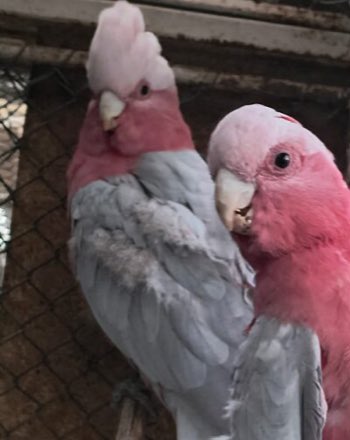
Růženka
Galah Eolophus roseicapilla
Looking for an adoptive parent- Born
- 2019
- In care since
- 2019
- Location
- Botanical Garden
Read the story
Růženka came to Laguna at the age of 3/4 of a year. Her owners left her at the vet's because they no longer wanted to go on treating her. Růženka had a long-running inflammation of the preen gland and subsequently scratched the skin on her rump raw. She was treated with antibiotics, but the inflammation came back several times. Once it had settled, she was placed with a breeder who had a young male living alone. But she did not last long there; she did not get on with the male at all. She returned to Laguna, and here she finally found her prince — Pepíček.

Rendy
Goffin's cockatoo Cacatua goffiniana
1 adoptive parent- Born
- 2005
- In care since
- 2020
- Location
- With a foster carer
Read the story
He was bought as a hand-reared, tame youngster into a family, where he became friends with a 6-year-old boy who looked after him. Sadly the family idyll did not last long: the boy's parents divorced and Rendy started screaming and plucking as well. So they moved the noisy Rendy to a parrot breeder. He stayed there a good while — until he was 15, when the breeder died. And so Rendy went back to his favourite boy. Except that over those years the boy had grown into a young student and had no time for a parrot. And so Rendy screamed again to force some attention. The young student could not study. And it was settled — Rendy would move to Laguna.
My adoptive parents Děkanová Barbora (since 3/2022)
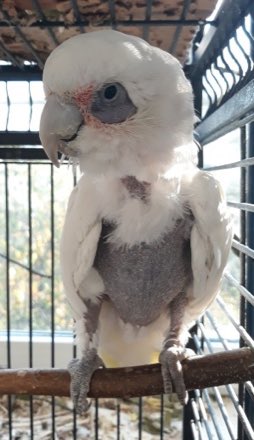
Kubíčka
Little corella Cacatua sanguinea
Looking for an adoptive parent- Born
- 2001
- In care since
- 2018
- Location
- With a foster carer
We have not written down a story yet.
 10 years in care
Kvika
Salmon-crested cockatoo Cacatua moluccensis
1 adoptive parent- Born
- 2012
- In care since
- 2016
- Location
- With a foster carer
Read the story
Kvika was taken in at Laguna after the tragic death of her beloved owner. Kvika first appeared at Laguna in December 2015 together with her friend Sophie, a white cockatoo, for a short stay because the owner had to go away. They made friends a little with the cockatoo gang, and then both girls went home again. Less than a year later — in the summer — both cockatoo girls turned up at Laguna again to be looked after while the owner went on holiday with her family. The stay suited them; the parrot girls treated it as a holiday too. But their return home lasted only a few days. Then a great tragedy happened: one evening their beloved owner went to bed early, she was not feeling well. And that was the last time she cuddled them. In the morning she did not wake up. Her health had not been strong and her weak heart could not take the hardships of recent times; it failed in the night. Her distraught husband contacted Laguna at once and the parrots were taken back to the cockatoo group. At first neither of the cockatoo girls understood why they were there so long, why their owner was not coming back for them. Only after several weeks did it dawn on them that she would never come. They took it very badly. Kvika was placed in the back quarters, because she needed constant entertaining and encouragement. She plucked a good deal of the time, screamed and was very unsettled. After a while she was placed in foster care in Chrastava near Liberec, in a large shared aviary with other parrots — and above all she met two male salmon-crested cockatoos there. One of them was badly plucked, the other looked very handsome. Perhaps because she was still working through her depression, she chose the handsome one and plucked him something dreadful. Hopefully it calmed her; she gradually put her grief behind her, and in the end she started playing in the aviary and even tidying up the nest box.
My adoptive parents Valhová Veronika (since 3/2021)
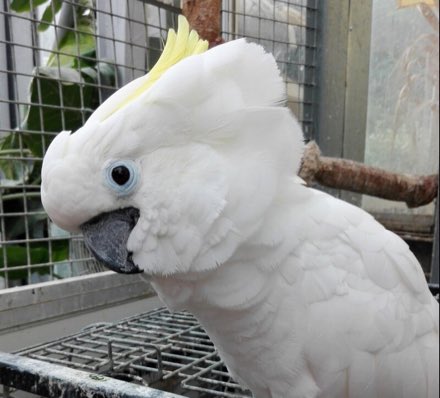 10 years in care
Angela
Sulphur-crested cockatoo Cacatua galerita
2 adoptive parents- Born
- 2013
- In care since
- 2016
- Location
- Botanical Garden
Read the story
A young, spirited female. Very playful and inquisitive. For her best friend and companion she chose the playful male Eddie. Angela was hand-fed from a completely naked hatchling. At three months old she was sold, while she still needed supplementary feeding. She started plucking. After a time she went back to the breeder, where she was kept alternately with an older pair of galahs and with young white cockatoos. This was not right for her either and she kept plucking. At the age of 3 she came to Laguna, where she had the chance to be with other large cockatoos and above all with males. She took a liking to ropes and swings and had room to fly in the aviary. In summer she enjoys the sun outdoors and natural rain. She forgot her plucking handicap completely and turned into a beautiful feathered lady. In the spring of 2019 she chose her male, Eddie. Together they were given their own aviary and are even starting to look into the nest box.
My adoptive parents Tamarka (since 12/2020), Jarcová Kristýna (since 8/2021)
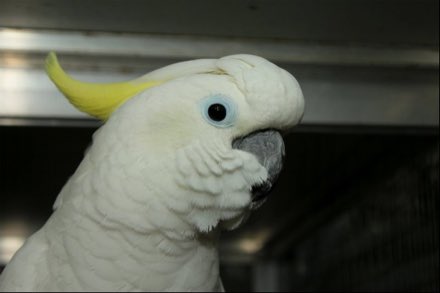
Chico
Sulphur-crested cockatoo Cacatua galerita
3 adoptive parents- Born
- 2013
- In care since
- 2017
- Location
- Botanical Garden
Read the story
Chico has a rougher temperament. He could not care less about anything — parrots or keepers alike. He can be cuddly, and just as quickly he will attack when he is having a bad day. He is rather active, needs keeping busy and is very talkative. Chico lived for three years in a care home for the elderly, Hortenzie. Lately it turned out that living in that facility was not right for him. He started having health problems too. He was moved to the cockatoo group at Laguna. Here he socialised quickly and gets along with the other cockatoos, though now and then he chases them about. He is quite dominant. He will let himself be stroked, but sometimes he can turn aggressive. He can imitate all sorts of sounds and likes shouting at visitors: “Hello, do you want a coffee, give me some water, Chico — the director” (just so everyone knows who is boss here!).
My adoptive parents Kamínová Daniela (since 8/2021), Skřivánková Adéla, Martina Zelenková (since 4/2026)
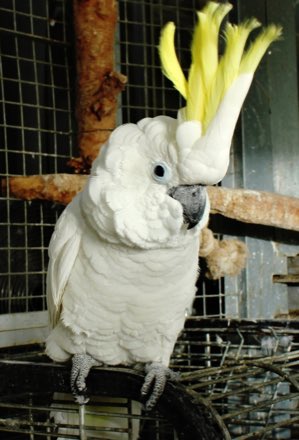
Eddie
Sulphur-crested cockatoo Cacatua galerita
1 adoptive parent- Born
- 2016
- In care since
- 2017
- Location
- Botanical Garden
Read the story
Eddie's owner had to move permanently to the USA — New York — for work. It was not possible to take the parrot to her new home; he would have been shut in a small flat alone all day. So she decided to place him at Laguna. Eddie is a very good-natured and quick-learning parrot. He seeks out no quarrels, socialised quickly with the other cockatoos and gets on well with them. His favourite became the young female Angela, with whom he earned a shared aviary of their own, with a nest box they are slowly starting to peek into.
My adoptive parents Václavíková Eva (since 1/2024)
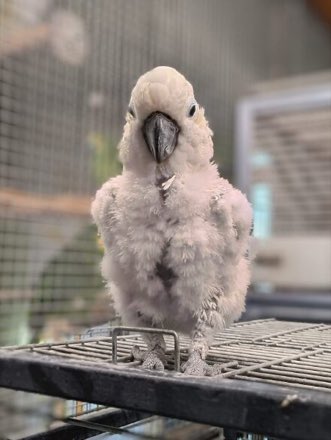
Koko
Sulphur-crested cockatoo Cacatua galerita
Looking for an adoptive parent- In care since
- 2024
- Location
- Luka pod Medníkem
Read the story
Koko and his bird friend, a red-and-green macaw, lived together for several years with their original owners on an old farm. The parrots did not like the farm much, they began plucking and took no joy in life. On top of that, Koko's macaw friend sadly fell ill and eventually died. Koko had a hard time coming to terms with losing his friend; his plucking got even worse and he tore out the feathers on his wings, belly and tail. The owners saw how Koko was suffering and decided to contact Laguna, where he would have the chance to find new bird friends. For now he is fearful and shy, but he is slowly getting used to his new friends and likes to dance and sing with the keepers.

Žolík
Sulphur-crested cockatoo Cacatua galerita
3 adoptive parents- Born
- 2009
- In care since
- 2018
- Location
- Botanical Garden
Read the story
Žolík came to Laguna at the age of nine, because he was aggressive towards his owner's partner. When she became pregnant, he turned on the newborn little person as well. He has got reasonably used to the flock of other cockatoos, but he rather keeps away from contact with them. From time to time his original owner comes to see him and helps with installing perches and with other work. Žolík responds to him nicely; you can see that he remembers him. Žolík likes contact with people, but what he likes best of all is the company of a singing keeper. Then you can see he is content.
My adoptive parents Vašíčková Markéta (since 5/2020), Vozníková Andrea (since 2/2021), Douda Karel (since 8/2023)
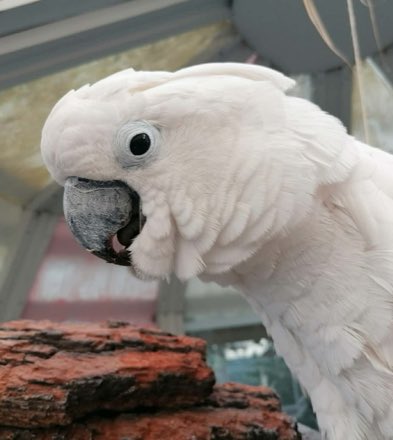
Albi
White cockatoo Cacatua alba
Looking for an adoptive parent- Born
- 2019
- In care since
- 14 December 2025
- Location
- Botanical Garden
Read the story
Albi's owner got him as a pet. He is a very calm, good-natured cockatoo, but of course once he reached adolescence he started putting the house in order his own way. He always got on well with the man, but he began attacking the wife. For safety he often had to stay in his cage, and he made his displeasure known by screaming. Shut in during the day, he would be let out of the aviary in the evening when everyone came home from work, and he would fly around the house. He was fed almost exclusively on sunflower seeds.
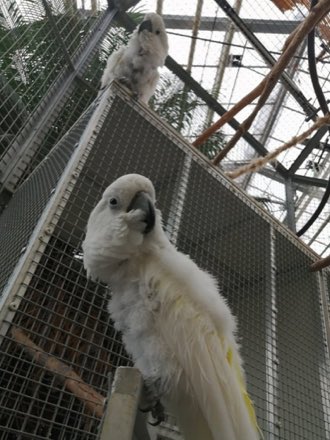
Bára
White cockatoo Cacatua alba
2 adoptive parents- Born
- 2007
- In care since
- 2019
- Location
- With a foster carer
We have not written down a story yet.
My adoptive parents Vaculínová Gabriela (since 2/2022), Vovsová Marcela (since 5/2022)
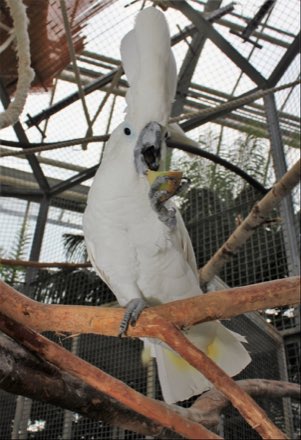 10 years in care
Barborek
White cockatoo Cacatua alba
4 adoptive parents- Born
- 2006
- In care since
- 2016
- Location
- Botanical Garden
Read the story
Barborek is a cheerful, affectionate and dominant male. His owner originally believed she had got a female, which is why Barborek kept a girl's name. He settled into the cockatoo flock quickly. He gives no trouble and gets on well with the other parrots and with some of the keepers. Barborek spent lovely years with his loving owner as a pet. After eight years he could not stay in his original home for family reasons and was placed at Laguna. His owner visits him regularly and always gives him her full attention. That resolved a difficult situation to the satisfaction of both sides. Barborek holds no grudge against her and still loves a cuddle with her.
My adoptive parents Rusnáková Tereza (since 10/2019), Šádková Zuzana (since 11/2019), Krišica Jiří (since 11/2019), Reiter Marion (since 10/2024)
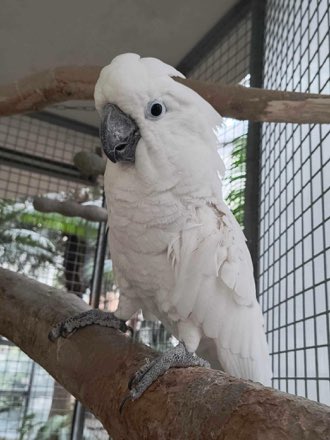
Coco
White cockatoo Cacatua alba
Looking for an adoptive parent- Born
- 2019
- In care since
- 2020
- Location
- Botanical Garden
Read the story
We took in Coco, a one-year-old cockatoo, from a pet shop. He suffers from hyperkeratotic changes to the skin of both feet — an overgrowth of hardened skin that has to be removed surgically. We now have to run many tests and try to rid him of this painful trouble.

Cookie
White cockatoo Cacatua alba
1 adoptive parent- Born
- 2002
- In care since
- 2020
- Location
- Botanical Garden
Read the story
Cookie went through about 5 homes in his life before he reached Laguna. He is a very sweet parrot, but highly sensitive, and the constant moving did him no good: he started plucking his feathers and learned to screech and shriek very loudly, which led to people getting rid of him. The last family he came to tried to give him everything he needed, but in time they decided he would be better off among other parrots and turned to Laguna. Cookie settled in with us quickly and gets on wonderfully with the other parrots he shares the aviary with at the Botanical Garden.
My adoptive parents Zuzana Prouzová (since 12/2024)

Ferda Junior
White cockatoo Cacatua alba
2 adoptive parents- Born
- 2018
- In care since
- 2018
- Location
- Botanical Garden
Read the story
Junior was the first egg of father Ferda and mother Sára. The parents did not yet know how to look after it — instead of sitting on the egg, father Ferda sat next to it and now and then played football with it. So the egg was moved to an incubator and replaced with a dummy, to give father something to kick about. Junior grew up together with his sisters, Shakira and later Safira. Once they had gained a little more strength and flying experience, they went to train in the tennis hall. Later they joined the cockatoo flock at the Botanical Garden, where they met their father Ferda for the first time. Sadly they never got to know their mother Sára; she died after a serious illness while they were still in the incubator. Father Ferda loves them immensely and either looks after them carefully or gets up to mischief with them.
My adoptive parents Košáková Veronika (since 11/2020), Jarcová Kristýna (since 8/2021)
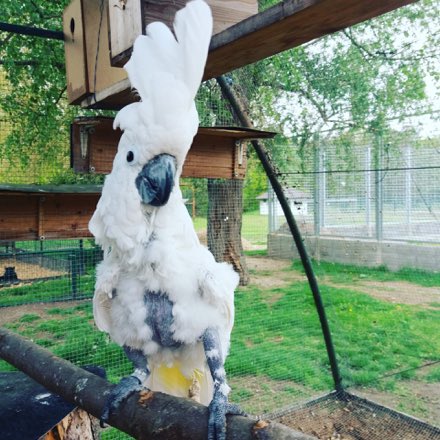 15 years in care
Josefína
White cockatoo Cacatua alba
3 adoptive parents- Born
- 2005
- In care since
- 2011
- Location
- With a foster carer
Read the story
Josefína is talkative, affectionate and cheerful. She likes human company and public events, where she can show off. She originally lived with her owner in America, and after some time she moved to Bohemia together with her owner. Her owner pampered her greatly and thought of her as an emancipated daughter. She fed her mainly on human food and poured her water into a mug only when Josefína asked for it, so that the water would not become contaminated. She had never known fruit or vegetables, and had never seen sunlight either. Probably from a lack of the nutrients she needed, she plucked the feathers from her belly and her back, and even damaged her skin into nasty sores. In 2011 she came to Laguna, where we had her fully examined and adjusted her diet according to the results. She began learning to eat fruit and vegetables. These new discoveries gave Josefína enormous joy. On tasting a banana, her big eyes simply rolled with an expression of: I don't know this, but it tasteeeees soooo goooood. She picked it up mostly from the other cockatoos, but she never managed to join the group. Her condition gradually improved and she partly regrew her feathers, though some follicles were already destroyed. She comes with us to public events, has her photo taken with models, and adores her keeper Ivanka, who has her in her care.
My adoptive parents Daníčková Anna (since 3/2021), Sojková Petra (since 4/2022), Tomáš Lukeš (since 2025)

Kašpárka
White cockatoo Cacatua alba
2 adoptive parents- Born
- 2000
- In care since
- 2020
- Location
- Botanical Garden
Read the story
Kašpárka and her owner found themselves, through great misfortune, in a very sad situation when the man they both loved left them after a serious illness. The two of them grieved so deeply that the world stopped being interesting to them. Kašpárka stared sadly at a colourful wall that, after a while, seemed to her only grey and colourless. At every click of the door she lit up and waited for her beloved to have come home, and it was only the unhappy owner, who tried to cheer Kašpárka up even though her own heart was bleeding. Her favourite pistachios stopped tasting good to her and she took no interest in anything new. Her toys just lay there without stirring. Life had stopped making sense to her. She began plucking her belly and the spark in her eye was going out. What to do? The owner grew unhappier and unhappier, because she could not even lift Kašpárka's mood. So she decided to place the female at Laguna, so as not to lose her as well. First she went into Laguna's home setting, where she made friends with the cockatoo Coco, who did tease her a little, but Kašpárka's appetite for life came back. Her favourite pistachios tasted even better than before, and the toys started to interest her again. Her activity shot right up. She was given a second chance at a new and completely different life — a bird's life, with plenty of other cheerful friends. For now she is still finding her feet in a group full of cockatoos, Coco her favourite among them, but we shall see which of the handsome lads she ends up liking best — and she has plenty of time for that.
My adoptive parents Steinbachová Jitka (since 1/2021), Jana Matoušková (since 12/2024)
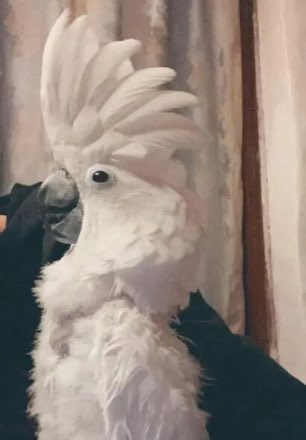
Káťa
White cockatoo Cacatua alba
2 adoptive parents- Born
- 2008
- In care since
- 2020
- Location
- With a foster carer
Read the story
Káťa came to Laguna at the age of two, and by then she had already been through several owners. We do not even know the whole history. Her last owner had her for half a year; before that she spent only a month with that woman's daughter, who had taken her from a friend, and he too had been given her by someone. The woman was at work all day, so Káťa spent most of her time alone. That is when she started plucking. She quickly formed a friendly bond with the woman and would lay eggs for her. She was fed a seed mix, mainly sunflower. Of fruit, she ate citrus most of all. Since the woman had no time for her, and Káťa screamed a good deal at home and was plucking heavily, she decided to place her at Laguna.
My adoptive parents Petrik Michaela (since 4/2020), Vojtková Ivana (since 6/2023)
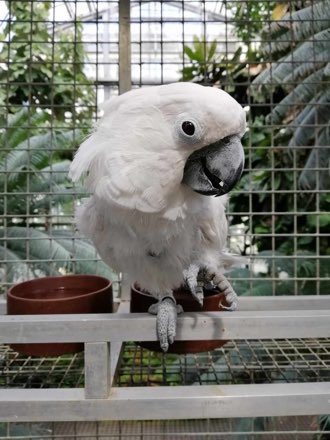
Kathy
White cockatoo Cacatua alba
Looking for an adoptive parent- Born
- 2007
- In care since
- 2018
- Location
- Botanical Garden
Read the story
Small, timid Kathy, who is afraid of the broom and of new branches. Kathy was taken in at Laguna plucked and frightened. With her previous owners she had started plucking in the first year of her life. She did like all kinds of fruit, but even so she was afraid of new things. She is afraid of the broom above all, during cleaning. She did not have an entirely standard name — she was called Kaďák, after the Czech word for cockatoo, kakadu. That name did not strike us as fitting for such a delicate female, so we named her Kathy.
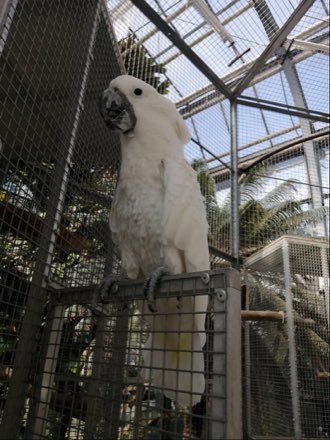 16 years in care
Koro
White cockatoo Cacatua alba
1 adoptive parent- Born
- 1990
- In care since
- 2010
- Location
- With a foster carer
Read the story
He came to us at the age of 20. A loving man had originally got him as his companion for life. They understood each other splendidly. But a problem arose every time a woman courting the man came into the house. Koro bravely set the hierarchy straight and, by the proper laws of cockatoos, literally drove the new partner out. The last human partner held out for a very long time. She tried every way she could to make some sort of peace with Koro. But Koro stood on principle: the partner must be eliminated. When, after one such exchange, the woman ended up in surgery with her face torn open, the man's nerves gave out and he built a large, safe little room for the cockatoo in the basement. He did not want to lose this partner after all — they were already expecting their human egg. So that Koro would not feel too hard done by, the man built a spacious aviary in the garden. But Koro would not accept this bargain and bellowed with all his might, as a proper cockatoo should. Complaints started arriving from the neighbours, and Koro was in trouble again. In despair, the man drove Koro to Laguna. He was first placed in the aviary at the Botanical Garden, among the cycads. Koro was immensely well behaved there and did not scream at all. And so after half a year Koro went back to his man, because it seemed the bellowing was behind him. It was not. Koro took a flight around the garden aviary, had a look around (which took about 3 minutes), gripped the bars tight, took a deep breath and launched into a serenade the likes of which the neighbours had never heard. It lasted several hours. That very same evening Koro returned to Laguna. After some time the chance came up to lend Koro to a breeder who had a female living alone. It was love at first sight. When Koro was let into the female's aviary a spark flew, and from then on they lived together. They climbed into the nest box, built themselves a little nest, had dinner together, and it all looked as though Koro might even become a father. Sadly, after a while the female died and Koro was alone again. He returned to Laguna, where within a week he took a liking to the loud female Bára, who made it clear to him that she is the dominant one. That is going to be quite a show!
My adoptive parents Luňáčková Lucie (since 2/2021)
24 years in careLora
White cockatoo Cacatua alba
Looking for an adoptive parent- Born
- 2002
- In care since
- 2002
- Location
- Botanical Garden
We have not written down a story yet.

Louis
White cockatoo Cacatua alba
2 adoptive parents- Born
- 2010
- In care since
- 2022
- Location
- Botanical Garden
Read the story
Louis was bought by his owner as a feathered chick that he was still hand-feeding. Together they formed a strong bond. When the man married and started a family, Louis stopped being the centre of attention. Then a dog joined the family as well and the parrot began plucking. He attacked the wife and the children. He plucked his wings and tail bare, so he could not even fly. You could see he was suffering, and so was the man, who because of his work no longer had time for him. So they decided to take Louis to Laguna, where in time he could join the cockatoo group and live a contented life in a flock of other friends.
My adoptive parents Vymlátil Petr (since 7/2022), Pavla Neumannová (since 10/2025)

Miky
White cockatoo Cacatua alba
Looking for an adoptive parent- Born
- 2017
- In care since
- 2019
- Location
- Botanical Garden
Read the story
Miky came to us as a still young cockatoo, not quite two years old. The family who had got him decided they were going on a trip around the world and no longer wanted the parrot. Miky did not let it bother him and very quickly joined the triplets — Junior, Shakira and Safira — who were of a similar age when Miky arrived, and he became their foster brother.
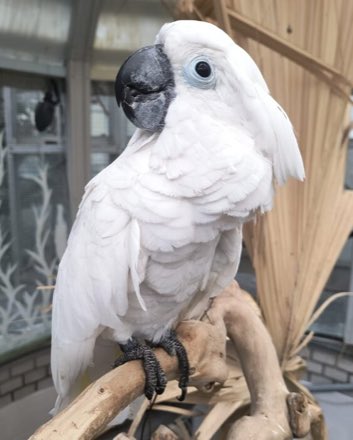 19 years in care
Rokýn
White cockatoo Cacatua alba
1 adoptive parent- Born
- 1999
- In care since
- 2007
- Location
- Botanical Garden of Charles University
Read the story
Rokýn is very affectionate and friendly, but also sometimes surprisingly sly and aggressive. Rokýn lived with a loving man who had got him as a chick. He raised him and cuddled him. They got through a rough adolescence too, but then something turned at home and the darling Rokýn began screaming unstoppably and then attacking his owner as well. Nothing could stop him. It tore the man's heart to move Rokýn to Laguna, but there was no other way. After arriving at Laguna the naughty screamer seemed transformed. He was a sweet little male again, who would let anyone cuddle him. It was not long before he started dive-bombing the keepers and screaming again. But he did not keep it up for long and understood that his screaming interests nobody and that attacking simply is not on. Instead of attacks and screaming he started playing among the parrots, and his mental state turned entirely for the better. His one great problem is with cleaning equipment, which simply makes the crest on his head go up. For all the care he gets, Rokýn has one serious handicap. He once suffered inflammation of the stomach and intestines. His digestion stopped and a great fight for survival began. A lot of medication did destroy the bacteria, but the stomach walls were damaged and proper digestion never returned. Rokýn cannot digest any grain, so he is on a special diet of soaked pellets and plenty of soft vegetables and fruit. He bravely coped with an illness we fought for several months, but his faith in us kept him going and gave us the chance to win.
My adoptive parents Nováková Michaela (since 1/2023)
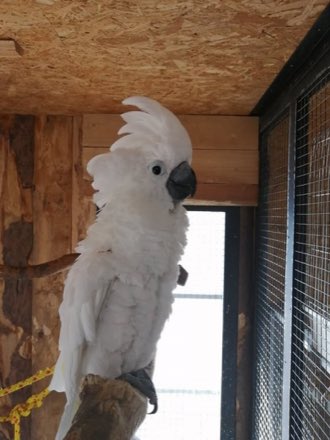
Saphira
White cockatoo Cacatua alba
1 adoptive parent- Born
- 2018
- In care since
- 2018
- Location
- Botanical Garden
Read the story
Safira is the daughter of her father Ferda and her mother Sára. She is the youngest of the triplets
My adoptive parents Kretová Lenka (since 4/2021)
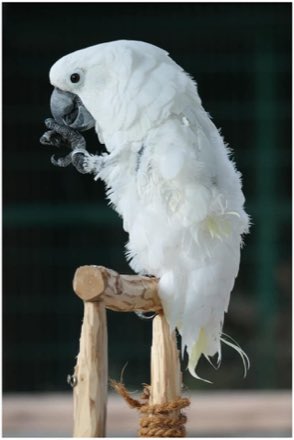
Shakira
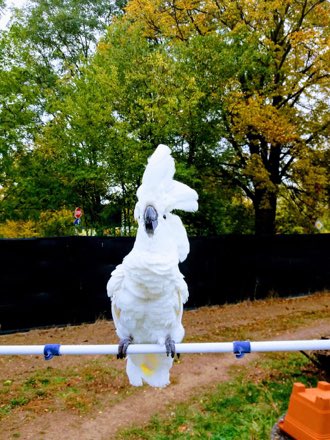
White cockatoo Cacatua alba
2 adoptive parents- Born
- 2018
- In care since
- 2018
- Location
- Botanical Garden
Read the story
Shakira is the first-hatched daughter of her father Ferda. She is the middle one of the triplets
My adoptive parents Pospíšilová Silvie (since 1/2021), Reiter Marion (since 10/2024)
 10 years in care
Sophie
White cockatoo Cacatua alba
2 adoptive parents- Born
- 2012
- In care since
- 2016
- Location
- Botanical Garden
Read the story
Sophie came to Laguna after the sudden death of her beloved owner. It took a long time before she put her grief behind her. Sophie first appeared at Laguna in December 2015 together with her friend Kvika, a salmon-crested cockatoo, for a short stay because the owner had to go away. They made friends a little with the cockatoo gang, and then both girls went home again. Less than a year later — in the summer — both cockatoo girls turned up at Laguna again to be looked after while the owner went on holiday with her family. The stay suited them; the parrot girls treated it as a holiday too. But their return home lasted only a few days. Then a great tragedy happened: one evening their beloved owner went to bed early, she was not feeling well. And that was the last time she cuddled them. In the morning she did not wake up. Her health had not been strong and her weak heart could not take the hardships of recent times; it failed in the night. Her distraught husband contacted Laguna at once and the parrots were taken back to the cockatoo group. At first neither of the cockatoo girls understood why they were there so long, why their owner was not coming back for them. Only after several weeks did it dawn on them that she would never come. They took it very badly. Sophie plucked herself and her mental state was poor. She was placed with Laguna's cockatoo mum Ivanka, who devoted whole days to her. Only after a year of being pampered did Sophie begin to wake from her heavy grief and become able to play with the other cockatoos again. She was moved into the group, where she gradually found her place, and started playing and larking about once more. Her feathers grew back and today she is a beautiful, self-assured young lady.
My adoptive parents Janoušková Lenka (since 1/2021), Stránská Kateřina (since 1/2021)
Macaws 13

Chaco
Blue-and-yellow macaw Ara ararauna
2 adoptive parents- Born
- 2019
- In care since
- 2019
- Location
- Luka pod Medníkem
Read the story
Chaco was reared by his parents Tereza and Richard. Chaco came into the world during dramatic days, when a vast fire was raging in South America and destroyed large parts of the rainforest. Laguna put together a project to help the burning part of the southern Pantanal in the Chaco. That is where the little parrot got his name, Chaco. In that period there was not so much time left for Chaco, but even so he grew into a wonderful little darling. Chaco has joined the free-flight training, though for now we can only fly freely in the tennis hall. He is very able and a greatly gifted flyer. One day he will fly under the open sky too.
My adoptive parents Janeba Bohuslav (since 2/2021), Jitka Kůželová
Evička
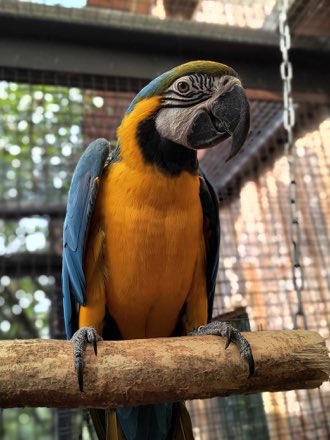
Blue-and-yellow macaw Ara ararauna
Looking for an adoptive parent- Born
- 2022
- In care since
- 2023
- Location
- Luka pod Medníkem
We have not written down a story yet.
Kasandra
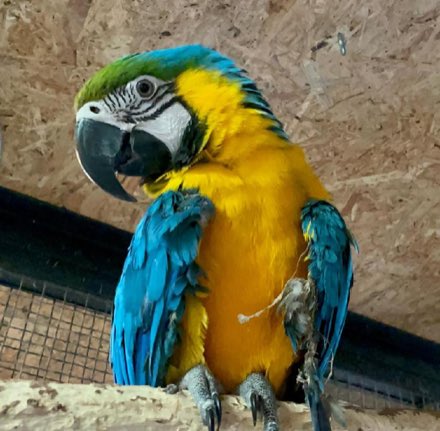
Blue-and-yellow macaw Ara ararauna
1 adoptive parent- Born
- 2021
- In care since
- 2023
- Location
- Luka pod Medníkem
Read the story
Kasandra, a two-year-old princess, was placed with us by a breeder because she flew badly and was not suitable for breeding. She had developed necrosis of the tissue at the tips of her wings and parts of the wings had to be amputated. Laboratory results revealed the bacterium Pseudomonas graminis, which had damaged the tissue and parts of the bones. The antibiotics put in place were chosen correctly; the laboratory confirmed the bacterium was sensitive to the antibiotics given. This bacterium is very rare; it occurs in France, where it is used in cleaning apples. How Kasandra came by it we shall probably never find out. After three weeks of treatment we hoped everything would be fine from then on. Sadly the left wing started going inflamed again and a second operation was needed, with part of the joint removed. Samples were taken once more and sent to the laboratory. And our girl has to have injections from the doctor again. On a follow-up X-ray we also found signs of an old fracture of the left wing. Who knows what happened to the poor thing early in life. For now she is holding up well and is not damaging the wound; hopefully it will all heal properly and Kasandra will finally get her wish and be able to join the other macaws. For now she only calls out to them from the first floor and gazes longingly out of the window, waiting for the day she can join her macaw mates.
My adoptive parents Lenka Král Joujová (since 8/2023)
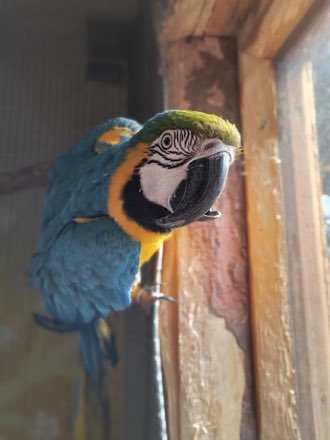
Kuba
Blue-and-yellow macaw Ara ararauna
Looking for an adoptive parent- Born
- 2002
- In care since
- 2022
- Location
- Luka pod Medníkem
Read the story
We took Kuba in at the age of twenty. We do not know his story, nor the reasons why there was no longer room for him at home. But we do know he needed help. Kuba has a beak handicap caused by incorrect hand-feeding in early youth. Feeding by tube or syringe can damage the growth part of the beak — and that is what happened to him. The result is a crooked beak whose upper part cannot wear down naturally. His beak overgrows and has to be professionally ground down by a vet at regular intervals. Despite this, Kuba is a very calm, patient and friendly parrot. He hit it off wonderfully with the macaw Manny, whose sight is impaired. Both are observers rather than wild things — and that is exactly why they understand each other. Kuba proves that even a parrot with a physical handicap can lead a full and dignified life. All he needs for it is a safe environment, care and a bit of friendship.

Manny
Blue-and-yellow macaw Ara ararauna
Looking for an adoptive parent- Born
- 2017
- In care since
- 2023
- Location
- Luka pod Medníkem
Read the story
The macaw Manny came to Laguna at the age of six. His life was turned upside down after his owners divorced. The woman had to move to a small flat and spent whole days at work, while the man often went away on long business trips. For a parrot who needs daily contact and a stable environment, that meant stress and loneliness. On top of that Manny went through a serious viral infection, after which he partly lost his sight. Because of his handicap he is now more cautious and does not feel secure among a large group of macaws. Even so, he found a new purpose with us — he paired up with the macaw Kuba, who has a beak defect and a very calm temperament. Together they make an unusual but beautifully matched pair. Parrots with special needs deserve love, attention and a safe home for a happy life too.
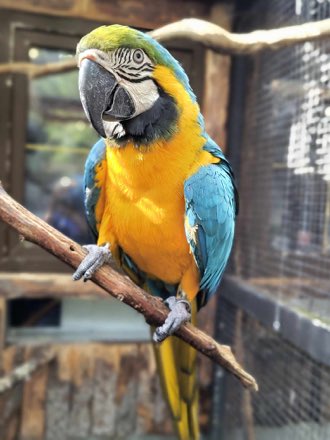
Rocky
Blue-and-yellow macaw Ara ararauna
Looking for an adoptive parent- Born
- 2023
- In care since
- 2024
- Location
- Luka pod Medníkem
We have not written down a story yet.
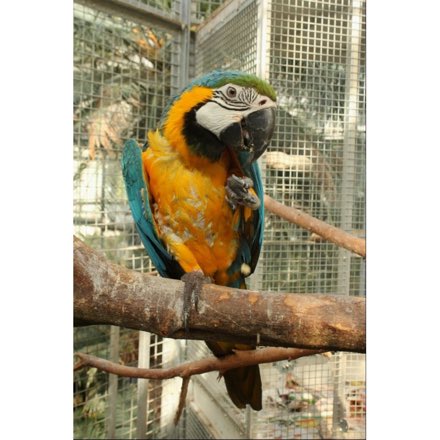 14 years in care
Sněhurka
Blue-and-yellow macaw Ara ararauna
4 adoptive parents- Born
- 2012
- In care since
- 2012
- Location
- Luka pod Medníkem
We have not written down a story yet.
My adoptive parents Opletalová Hana (since 4/2020), Mosrová Tereza (since 5/2025), Báštecká Barbora (since 5/2025), Dana Zimovčáková (2025)

Zorinka
Blue-and-yellow macaw Ara ararauna
1 adoptive parent- Born
- 2022
- In care since
- 2023
- Location
- Luka pod Medníkem
Read the story
A blue-and-yellow macaw, a two-year-old girl who has nothing wrong with her at all. But her owner is in a bad way. She took Zorinka in while she was still a small chick. She looked after her nicely for almost two years. They spent a lot of time outdoors in the garden. But the owner's health let her down and she was often in hospital. Kind neighbours looked after Zorinka, coming in to feed her and clean up. But she was alone in the house a great deal. The owner's health got worse and she had to go back into hospital, and it does not look good at all. And so she decided it was better to place her beloved macaw at Laguna. Zorinka has found a friend here in Kasandra, and the two have plenty to talk about, because Kasandra has a very dramatic story behind her. At least we send the owner videos and keep her informed about how her macaw is doing. If the owner's health does not improve enough for her to take her back, she will at least come and visit. Some owners can look after their parrots and do not, and here is a woman who would like to and cannot. Life sometimes takes a turn with us before we can so much as blink.
My adoptive parents Ondřej Krumpolec (since 10/2025)
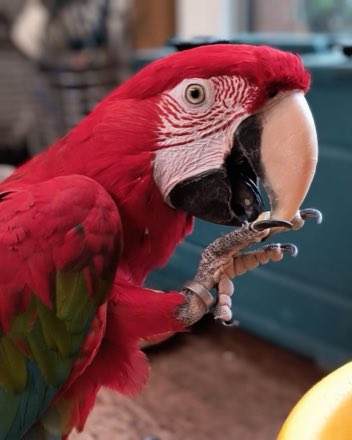
Klára
Red-and-green macaw Ara chloropterus
2 adoptive parents- Location
- Luka pod Medníkem
We have not written down a story yet.
My adoptive parents Andrea Franková (12/2024), Silvie Papoušková (2025)
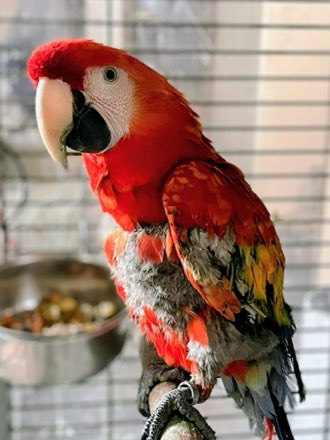
Syrax
Scarlet macaw Ara macao
Looking for an adoptive parent- Born
- May 2023
- In care since
- 27 December 2025
- Location
- Luka pod Medníkem
Read the story
The macaw Syrax lived with a breeder along with other blue-and-yellow macaws and with her sibling. Early on she was the only one who began plucking. She underwent some examinations, but the doctor found no cause. She then plucked the male who shared her aviary as well. After the sudden death of her companion she plucked herself completely bare, tearing out her tail and wings. The breeder decided to change her home, because she no longer knew what to do with her. The breeder's other macaws are beautifully feathered and never plucked.

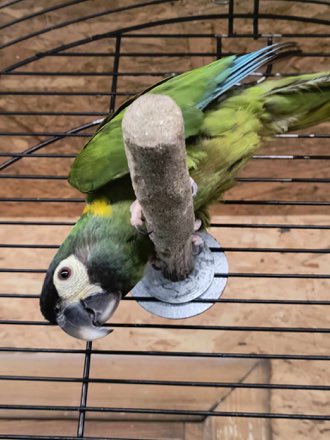
Hilda
Yellow-collared macaw Primolius auricollis
Looking for an adoptive parent- Born
- 2015
- In care since
- 2023
- Location
- Luka pod Medníkem
Read the story
The owner bought the macaws Hilda and Škubánek as a breeding pair. The male showed great nervousness from the start, was discontented and soon began plucking. From the age of three they reared young, but the whole time they were plucking invasively.
 10 years in care
Merlinka
Yellow-collared macaw Primolius auricollis
3 adoptive parents- Born
- 2016
- In care since
- 2016
- Location
- Luka pod Medníkem
We have not written down a story yet.
My adoptive parents Tihelková Alice (since 2/2021), Horáčková Zdenka (since 8/2023), Ondráčková Miroslava (since 1/2021)
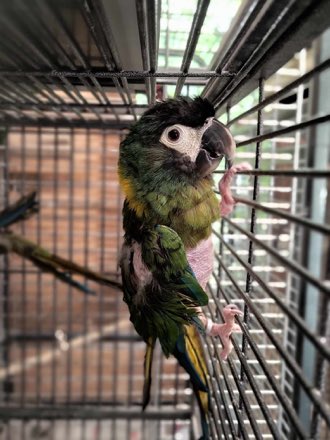
Škubánek
Yellow-collared macaw Primolius auricollis
1 adoptive parent- Born
- 2014
- In care since
- 2023
- Location
- Luka pod Medníkem
Read the story
The owner bought the macaws Hilda and Škubánek as a breeding pair. The male showed great nervousness from the start, was discontented and soon began plucking. From the age of three they reared young, but the whole time they were plucking invasively.
My adoptive parents Filip Goll (4/2025)
Grey parrots 14

Artur
Grey parrot Psittacus erithacus
1 adoptive parent- Born
- 2006
- In care since
- 2021
- Location
- With a foster carer
We have not written down a story yet.
My adoptive parents Maroušková Gabriela (since 11/2021)
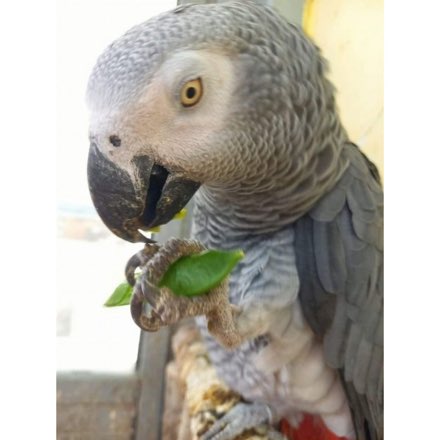
Berťas
Grey parrot Psittacus erithacus
Looking for an adoptive parent- Born
- 2010
- Location
- Luka pod Medníkem
Read the story
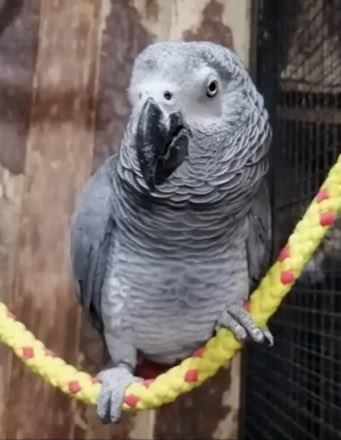
The grey parrot was bought at a Zverimex pet shop and lived a contented life with his owners for several years. When a child was born into the family, the grey parrot started plucking a little. He was most likely competing for affection that way. After some time the daughter began having health problems, and it was confirmed that the little girl has a strong allergy to the dust from their grey parrot's feathers. The parrot was subsequently placed at Laguna.
Bertík
Grey parrot Psittacus erithacus
4 adoptive parents- Born
- 2015
- In care since
- 2019
- Location
- With a foster carer
Read the story
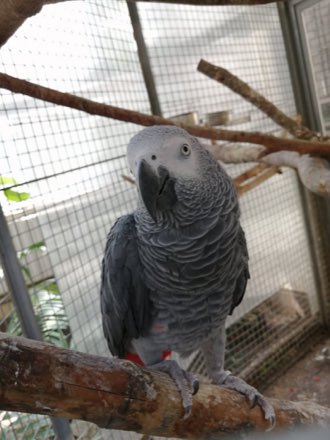
Because of aggressive attacks on the lady of the house and on a newborn member of the family, he had to be taken in at Laguna, where he joined a group with other parrots.
My adoptive parents Janečka Luděk (since 3/2021), Kobzová Šárka (since 4/2022), Miščíková Ingrid (since 8/2022), Hlinková Ivana (since 02/2023)
Frodo-Koko
Grey parrot Psittacus erithacus
Looking for an adoptive parent- Born
- 2019
- In care since
- 2020
- Location
- With a foster carer
We have not written down a story yet.

Karel
Grey parrot Psittacus erithacus
Looking for an adoptive parent- Born
- 2018
- In care since
- 2021
- Location
- With a foster carer
We have not written down a story yet.

Kubíček
Grey parrot Psittacus erithacus
Looking for an adoptive parent- Born
- 2004
- In care since
- 2023
- Location
- Luka pod Medníkem
We have not written down a story yet.
 10 years in care
Kubína
Grey parrot Psittacus erithacus
5 adoptive parents- Born
- 2007
- In care since
- 2016
- Location
- With a foster carer
We have not written down a story yet.
My adoptive parents Henešová Alena (since 1/2020), Madzinová Veronika (since 3/2023), Navrátilová Dana (since 1/2022), Michaela Ničová (since 1/2021), Renata Hánová (since 2025)
Max
Grey parrot Psittacus erithacus
Looking for an adoptive parent- Location
- Luka pod Medníkem
We have not written down a story yet.
Pipi-Kuba
Grey parrot Psittacus erithacus
Looking for an adoptive parent- Born
- 2007
- In care since
- 2019
- Location
- With a foster carer
We have not written down a story yet.
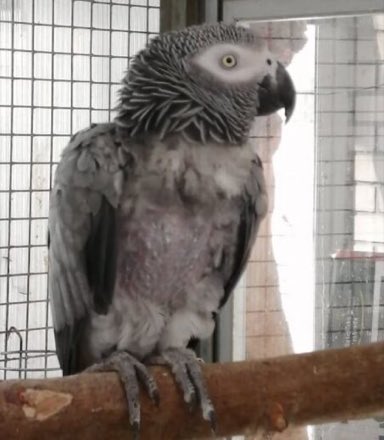
Sára
Grey parrot Psittacus erithacus
1 adoptive parent- Born
- 2010
- In care since
- 2021
- Location
- With a foster carer
We have not written down a story yet.
My adoptive parents Kulíková Jitka (since 1/2021)
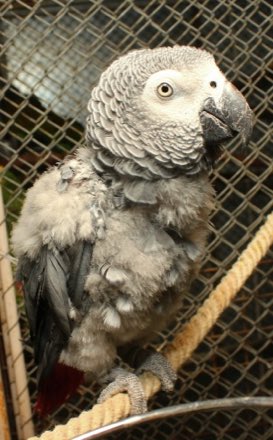
Snowy
Grey parrot Psittacus erithacus
4 adoptive parents- Born
- 2015
- In care since
- 2017
- Location
- Botanical Garden
We have not written down a story yet.
My adoptive parents Kubín Vlastimil (since 1/2021), Štěpán (since 3/2024), Rettková Barbara (since 12/2024), Vášová Eva
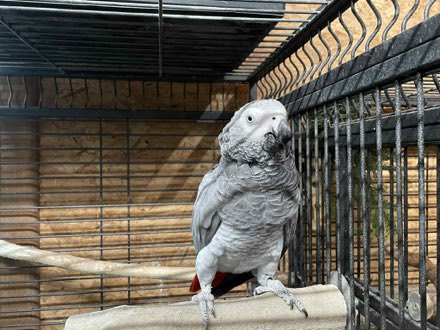
Terezka
Grey parrot Psittacus erithacus
3 adoptive parents- Born
- 2002
- In care since
- 2022
- Location
- Botanical Garden
Read the story
The grey parrot Terezka comes from Bošovice Zoo, where she was reared as a chick. A married couple bought her and looked after Terezka exemplarily. As the years went on the owners grew old and the woman died. The man was left alone and could no longer manage caring for the parrot. Their son could not look after Terezka, so he preferred to place her at Laguna. Lately she has started plucking a little, probably partly because of her owner's passing. Her diet was also too fatty. You can see it in her colouring too — now and then she has pink feathers, a sign that her food ration needs adjusting to a lighter diet. She is very lively, watches the flock of grey parrots and will soon be joining them. Lately her feathers have grown back beautifully and she has turned into a lovely grey parrot young lady.
My adoptive parents Adamcová Alexandra (since 1/2023), Kreuzová Karla (since 8/2022), Hladíková Hana (since 6/2025)
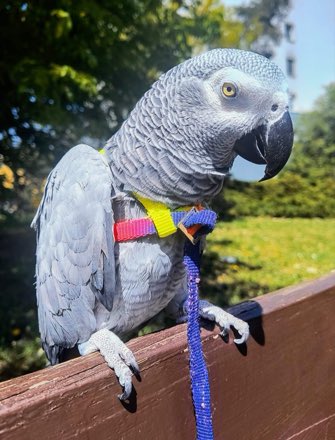
Žofie
Grey parrot Psittacus erithacus
2 adoptive parents- Born
- 2007
- In care since
- 2023
- Location
- Botanical Garden
We have not written down a story yet.
My adoptive parents Jiřina Babická (12/2024), Jiří Prosman (2025)
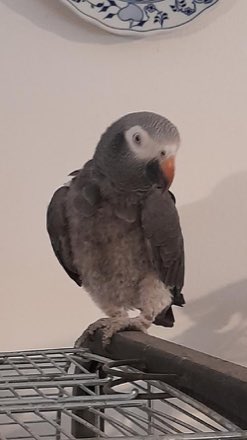
Kačenka
Timneh parrot Psittacus timneh
1 adoptive parent- Born
- 2003
- In care since
- 2021
- Location
- With a foster carer
Read the story
The grey parrot Kačenka hatched in September 2003 at a private zoo in Istanbul. From there she was bought at the age of two by her owner, who at the time was in Turkey on official duty as an ambassador, together with his wife. Kačenka lived with them in a flat at the Consulate General of the Czech Republic in Istanbul. After two years the man was recalled to the Czech Republic. So he arranged all the necessary permits and he and Kačenka moved to the Czech Republic together. Here they lived contentedly in a family house, where Kačenka had her own large aviary and her own room. She was out for most of the day and the owners gave her their attention. Time passed, the owners were getting on in years and they moved to the countryside into a smaller home. Here Kačenka no longer had that much freedom, the owners' strength was fading, and so they decided to move Kačenka to Laguna, so that she would have the chance to find friends of her own and perhaps a partner too. She came to Laguna in the summer of 2021, at the age of 18. At first she rather eyed up the new people and friends. Laguna's flock of grey parrots is made up of Congo greys, and Kačenka is a Timneh. So she was placed on trial with one of our breeders, who also has a Timneh — an older boy called Pepa. Here Kačenka is no longer timid; quite the opposite — she keeps Pepa nicely in line. So let us hope the two of them get along.
My adoptive parents Sojková Petra (since 5/2023)
Amazon parrots 25
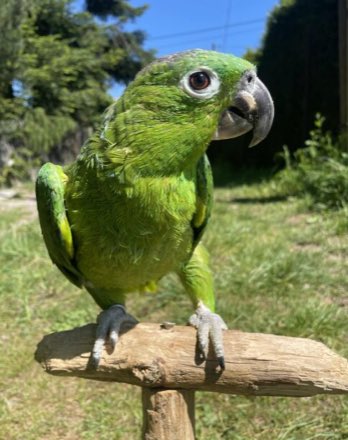
Frencis
Mealy amazon Amazona farinosa
2 adoptive parents- Born
- 2021
- In care since
- 2023
- Location
- Luka pod Medníkem
Read the story
A kind woman found the wretched Frencis, an amazon only a year old, in the cellars of a pet shop. She managed to buy her out, and within a year the sad heap of feathers turned into a pretty amazon girl. The woman put her in a large aviary with white cockatoos, where Frencis could fly and build up her strength. After a while the comedian cockatoos took it into their heads to tear the feathers out of the amazon's wings and tail. And Frencis was plucked and broken again. The woman arranged a move to Laguna, where Frencis could recover and find friends who were her equals. Frencis is a wonderful girl, very sociable. She likes going to Laguna's public events and enthusiastically tells all her admirers about the things she has been through. She cannot be understood, but nobody minds. And Frencis's wing and tail feathers are slowly growing back, and her self-confidence is growing back along with them. She is a magnificent, sociable lady. For now she sticks with people more than with parrots, but once her flight feathers grow back she will show them all.
My adoptive parents Blanka Hrdinová (since 1/2026), Andrea Franková (2026)
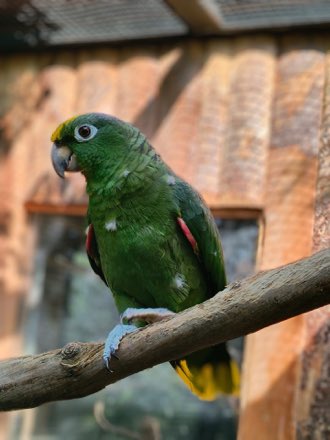
Puppy
Mealy amazon Amazona farinosa
Looking for an adoptive parent- Born
- 1990
- In care since
- 2022
- Location
- Luka pod Medníkem
Read the story
We know nothing at all about a large part of his life; we only know that his owner took him over from people where he had been shut in a small cage for several years. The woman was at home on maternity leave, so she had plenty of time for the parrot. At first he was very aggressive and destroyed everything around him. The woman adjusted his diet and gave him plenty of movement all around the flat. He soon calmed down and became a house pet, and he was good to everyone except the owner's partner, whom he attacked. Sadly, after a while he attacked one of the children as well. At first they put it down to some short circuit caused by a memory from his earlier life. But after a while he attacked another child, and when the owner fended off the attack, from then on he started attacking her too. He became very discontented and aggressive. The woman did not want to shut him in a cage, but for the family's safety and also for the parrot's own contentment she decided to get in touch with Laguna and arrange a move. Puppy was put in with the large group of amazons very soon. And as if he had been there from the start, within a short time he joined the turquoise-fronted amazons. After some time the mealy amazon Frencis arrived at Laguna. But Puppy did not give her a single glance; he still keeps company with the turquoise-fronted ones.
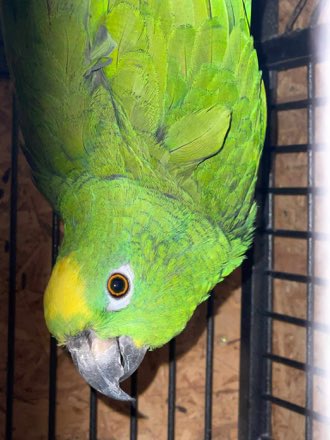
Emil
Natterer's amazon Amazona ochrocephala nattereri
Looking for an adoptive parent- Born
- unknown
- In care since
- 2020
- Location
- Luka pod Medníkem
Read the story
Some people brought Emil to Biopark Štít, because he was blind and they did not want to go on looking after him. He lived there alone in a cage for several years. Then we agreed to move him to Laguna, so that he would at least have friends here. After some time he made friends with the amazon Loras, who got on badly with the others in the group but took a liking to Emil.

Vanda
Natterer's amazon Amazona ochrocephala nattereri
Looking for an adoptive parent- Born
- unknown
- In care since
- 2020
- Location
- Luka pod Medníkem
Read the story
Vanda came to Laguna as a partner for the amazon Wendy. She was provided by a breeder who had not used her for breeding. From the start, however, Wendy and Vanda showed no interest in each other at all and ignored one another completely. Vanda immediately made friends with the group of turquoise-fronted amazons and did not give Wendy a single glance.
Wendy
Natterer's amazon Amazona ochrocephala nattereri
Looking for an adoptive parent- Born
- 2006
- In care since
- 2018
- Location
- Luka pod Medníkem
Read the story
Wendy was originally an unsuitable wedding present. The newlyweds kept him for about half a year, but then they passed him on. A kind woman took him in and gave him a great deal of attention. She was his partner. But everything changed when the owner had a baby. Wendy was not prepared to put up with such a change and began attacking the small child. There was no other way and the parrot had to leave the house. At Laguna he behaves very dominantly. It was not possible to put him in with the amazon flock, as he chased all of them. He gets on very well with the keepers; he is an entertaining and likeable chap. He likes flying out into the outdoor aviary and stays outside even in the rain. He was put in with the group of blue-and-yellow macaws. Although he takes them on as well and pulls their tails, the macaws can handle him and drive him off. He earned the largest macaw aviary out of it. He is a very clever, capable fellow.

Bára
Orange-winged amazon Amazona amazonica
3 adoptive parents- Born
- 2003
- In care since
- 2020
- Location
- Luka pod Medníkem
We have not written down a story yet.
My adoptive parents Vaculínová Gabriela, Vovsová Marcela, Ivana Navrátilová (6/2026)
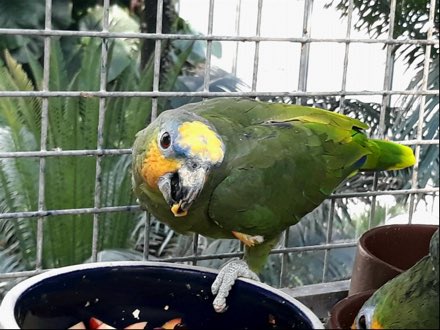 14 years in care
Edu
Orange-winged amazon Amazona amazonica
1 adoptive parent- Born
- 2012
- In care since
- 2012
- Location
- Luka pod Medníkem
Read the story
Edu is a genetically very valuable offspring of parents from the wild, and the offspring of one of the oldest amazons at Laguna — Eduard — and he was reared by his parents.
My adoptive parents Vacková Lucie (since 4/2021)
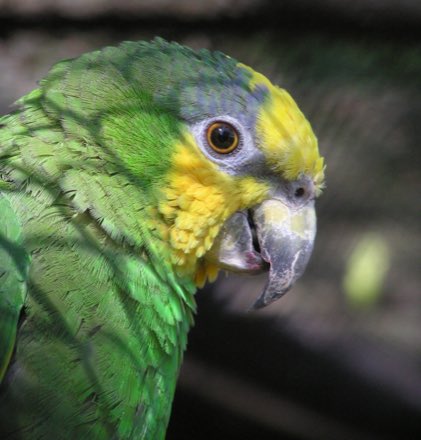 19 years in care
Eduard
Orange-winged amazon Amazona amazonica
4 adoptive parents- Born
- 1993
- In care since
- 2007
- Location
- Luka pod Medníkem
Read the story
One of the oldest amazons in the flock. He comes from the wild — he was seized at an airport as illegal trade. He was placed in the socialisation group of amazons at Laguna. Eduard was seized at the airport together with others in 1993 and placed at Prague Zoo. His age is not known. In 2007 Laguna obtained him in exchange for other birds. Laguna tried to make up for the loss of the rainforest by housing him in a large aviary in the tropical greenhouse at the Botanical Garden of Charles University. Eduard also reared offspring in captivity. One of the chicks (named Edu) flies with him in the group. For several years he was the “boss” of the amazon group. Today he is getting old and losing strength, but he is not quarrelsome. He has got used to the keepers too and will take fruit from the hand.
My adoptive parents Fialová Olga (since 1/2019), Tamarka (since 12/2020), Vacková Lucie (since 4/2021), Kristyna Viktorová (since 5/2026)

Samík
Orange-winged amazon Amazona amazonica
Looking for an adoptive parent- Born
- 2010
- In care since
- 2023
- Location
- Luka pod Medníkem
We have not written down a story yet.

Angelika
Red-lored amazon Amazona autumnalis
1 adoptive parent- Born
- 2008
- In care since
- 2023
- Location
- Luka pod Medníkem
We have not written down a story yet.
My adoptive parents Blanka Hrdinová (since 2/2026)

Joffrey
Red-lored amazon Amazona autumnalis
Looking for an adoptive parent- Born
- 2008
- In care since
- 2023
- Location
- Luka pod Medníkem
We have not written down a story yet.
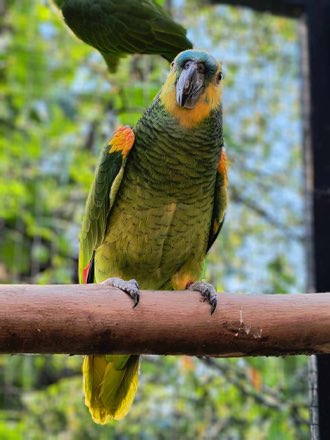
Harry junior
Turquoise-fronted amazon Amazona aestiva
Looking for an adoptive parent- Born
- 2019
- In care since
- 2019
- Location
- Luka pod Medníkem
Read the story
Harry hatched at Laguna; he is the offspring of Harry and Kirra.
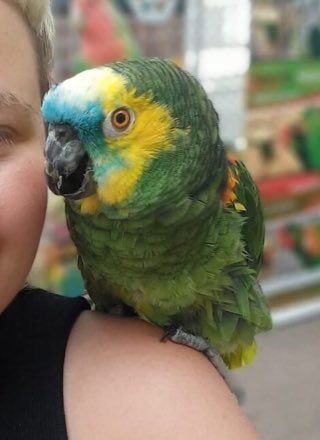 16 years in care
Harýček
Turquoise-fronted amazon Amazona aestiva
2 adoptive parents- Born
- 2000
- In care since
- 2010
- Location
- Luka pod Medníkem
Read the story
Harýček's story begins much like a great many other situations in ordinary families. Dad, mum, a little son… The boy grows up, goes to school, gains a bit of sense, and wants a friend terribly, terribly badly — a dog. After much family debate, Christmas comes and there is a small furry bundle under the tree — behold, a Yorkshire terrier puppy! There is no limit to the excitement. The boy writes his homework exemplarily, tidies up after himself, takes out the bin and, as agreed, walks the dog in the afternoons. Then comes the era of computer games and less time, and the dog attaches itself to mum, because she is the one who always makes it out for a walk and always fills the food bowl. The son grows, grows wiser, and takes an interest in parrots. The dog still only cuddles with mum. Pleas, promises, laments about how hard he will study, how he will not spend time at the computer, really. And that tiny amazon at the PET centrum shop is so lonely and sad. And then that birthday — and behold — the amazon is home. The son's joy knows no bounds; he even washes the dishes and takes out the bin unasked. And in the end the whole family grows fond of the amazon. And Harýček lives in the son's room, repeats various words and is a great friend. The boy studies as promised, as best he can. So a fine end to the story? Except that something is changing. The little boy is changing. Adolescence begins, hard, loud music, and Harýček screams endlessly. Why??? Nobody understands what changed about the amazon. Nothing changed about Harýček. But the boy is slowly growing up, the amazon cannot bear hard rock music and bellows, and bellows and bellows. All day long. And so he travels to mum in the kitchen. Except Harýček goes on bellowing. Patient mum at least thinks up a programme for him — he goes with them to the cottage. Harýček loves that immensely. Not only does he like it enormously at the cottage, because there he has a little aviary in the garden under an apple tree, but there is also tremendous fun along the way. Mum drives and dad drives mum: “Right, into the right lane, ri— you idiot.” I have no idea what went on along the way, but Harýček has kept these lines to this day, along with other chatter and imitating the barking of his dog friend. And as time went on, the situation somehow got even worse. The son really did study well, got into a school and left for a boarding school in another town. And so Harýček was left alone, because he had been very fixated on the boy. He no longer even enjoyed the trips to the cottage, he was weary, he attacked dad and mum and above all — he screeched, screamed and shrieked, all day long. And on top of that he plucked himself, as if that were not enough. And at that point dad could take no more and decided: the amazon is leaving the house. But what to do with him? And so Harýček was taken in at Laguna. Here, after a short time, he was given the female Kirry, who has a rare condition — she is allergic to the dust from other birds' feathers. It shows that parrots suffer from illnesses very similar to ours. It took a long time before he got used to Kirry and understood that she is his mate, not a Yorkshire terrier. Only after two years of living with Kirry did Harýček stop “barking” like a dog and turn his attention to his amazon mate. Today Harýček still plucks a little, but he looks after his mate carefully. Because of her diagnosis, Kirry has to be in a large, airy aviary, as isolated as possible from any allergens. From spring to autumn they are both placed in the outdoor aviary and enjoy the clean air of the Sázava valley. In the summer of 2019 they started behaving mysteriously and we had no idea what was going on in their aviary. Every day we brought them fresh food and clean water, and both amazons always waited by the bowls to see what they would get. After a while only Harýček was waiting at the bowl, and Kirry was tucked away in the nest box. We discreetly took a look to see whether any eggs might be visible. And behold, there were two beautiful grey spheres. Tears sprang to our eyes with joy and we quietly withdrew to rejoice elsewhere, so as not to disturb them. Together, without any human hand, they raised a girl and a boy.
My adoptive parents Hlaváč Jindřich (since 3/2020), Fialová Olga (since 4/2020)
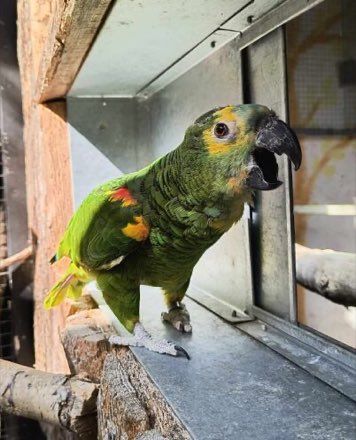
Herink
Turquoise-fronted amazon Amazona aestiva
Looking for an adoptive parent- Born
- 2004
- In care since
- 2020
- Location
- Luka pod Medníkem
Read the story
Herink was a present for a 60th birthday from a friend who had originally been given the parrot as a present too. He lived in the household as a spoiled companion, fed unsuitably the whole time on a mix of fatty grain with peanuts and nuts, now and then human food, and chocolate and biscuits as treats. Around adolescence the first dive-bombing and attacks started, the man began to be afraid of Herink, stopped taking him to the pub and stopped letting him out of his cage. At Laguna he soon joined the flock, but he still attacks people.
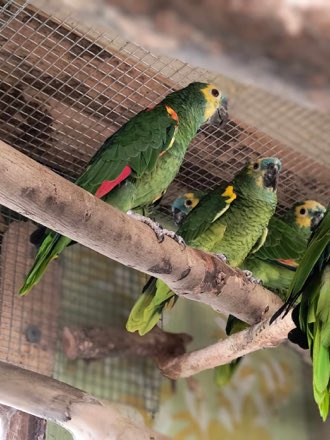
Ivan a Marta
Turquoise-fronted amazon Amazona aestiva
1 adoptive parent- Born
- 1985, 2005
- In care since
- 2023
- Location
- Luka pod Medníkem
Read the story
Ivan came with the older female Marta as her second partner. Marta is one of the oldest amazons we have here. The owner of both amazons died and his wife could no longer look after the parrots, so she had them all brought to Laguna.
My adoptive parents Tomáš Sýs (since 10/2025)
 13 years in care
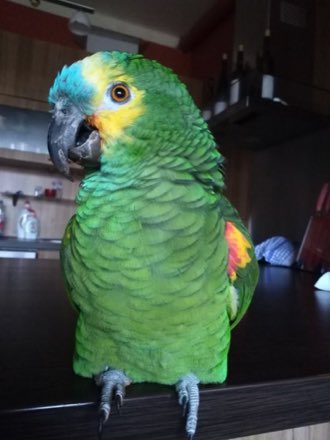
Jack
Turquoise-fronted amazon Amazona aestiva
1 adoptive parent- Born
- 2000
- In care since
- 2013
- Location
- With a foster carer
Read the story
Jack was got by parents for their daughter when she was a child. Jack loved her and they were great mates. But the daughter grew up, had her own interests, and eventually grew up and moved away from her parents. Jack stayed with the father, whom he did not much like. He missed his friend, whom he loved. The father did everything he could to make Jack happy. He took him to work, where Jack had an aviary. He worked at a theatre, and from there Jack learned to whistle various melodies. As time went on, Jack suffered more and more and was not happy. So his sad owner handed him over to Laguna. We tried to get him into the amazon group, where Jack came into conflict with Harýček, of the same species. It ended with both of them on the operating table, and fortunately both survived. Jack tried living with one female as well, but that did not work out either. After that he was with a family for about 3 years, where they had a small baby — and so Jack learned to cry like an infant. At present Jack has been with our keeper Ivettka for 5 years. He is content and used to human contact. Both Jack and Ivettka are content and happy. They are an inseparable pair.
My adoptive parents Sýs Tomáš (since 3/2022)
 15 years in care
Kirry
Turquoise-fronted amazon Amazona aestiva
1 adoptive parent- Born
- 2001
- In care since
- 2011
- Location
- Luka pod Medníkem
Read the story
Kirry was bought as a ten-year-old female for Harýček, at the time our only turquoise-fronted amazon, so that he would not be alone. After some time Kirry began showing unusual breathing difficulties, and it gradually emerged that she is allergic to the feather dust of other parrots (cockatoos in particular). She spent the summer season outdoors, and for the winter she was placed in the greenhouse of the botanical garden, where the climate was ideal for her. She and Harýček reared 2 chicks on their own.
My adoptive parents Sýs Tomáš (since 3/2022)
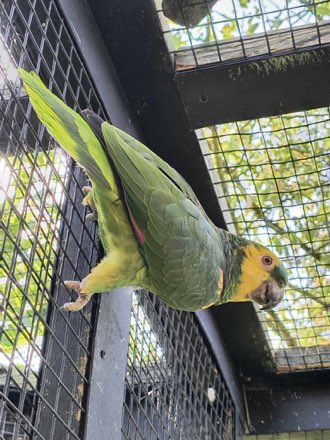
Kirry junior
Turquoise-fronted amazon Amazona aestiva
1 adoptive parent- Born
- 2019
- In care since
- 2019
- Location
- Luka pod Medníkem
Read the story
Kirry Junior hatched at Laguna as a twin with her brother Harry Junior.
My adoptive parents Tomáš Sýs

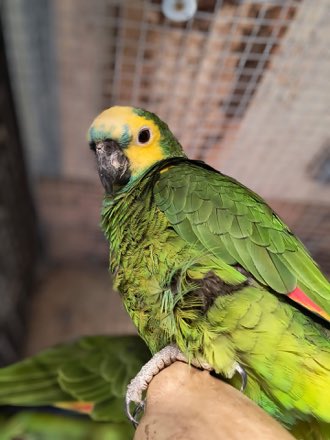
Kryštof
Turquoise-fronted amazon Amazona aestiva
Looking for an adoptive parent- Born
- 2009
- In care since
- 2024
- Location
- Luka pod Medníkem
Read the story
The amazon Kryštof was originally an unwanted gift. He changed owners several times before, after nine years, he came to his beloved owner. They became great friends and lived contentedly together for six years. Sadly the owner fell seriously ill and had to go into hospital for a long time. Kryštof was looked after by the owner's partner, but unfortunately Kryštof does not like her at all and attacks and goes for her whenever he can. Even though the woman tried to keep Kryštof happy, it was all in vain. In the end the owner decided to send Kryštof to Laguna, among other friends. And he follows his new life at Laguna at least from a distance, from the hospital.
Kubík
Turquoise-fronted amazon Amazona aestiva
Looking for an adoptive parent- Born
- unknown
- In care since
- 2021
- Location
- Luka pod Medníkem
Read the story
The owner acquired many different parrots in cages in her flat and tried to raise them as pets. That is how she acquired Kubík, who was already older. After some time her family circumstances became complicated, and with them the owner's physical and mental state. She was in such a bad way that she could no longer look after the parrots at all and asked for help. Many parrots had to be rescued from the flat in a hurry, from 7 indoor aviaries in all. The change did Kubík good; he joined the flock and finally found green friends of his own.

Lóra
Turquoise-fronted amazon Amazona aestiva
Looking for an adoptive parent- Born
- 2003
- In care since
- 2023
- Location
- Luka pod Medníkem
Read the story
The amazon Lóra lived in a family as a pet; as she reached adulthood she became discontented with her two-legged friends and stopped wanting cuddles. The owners wanted to give her a better life among other amazons and turned to Laguna.
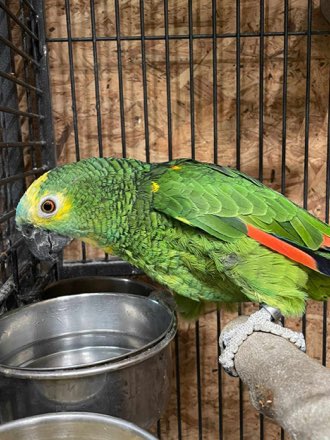
Loras
Turquoise-fronted amazon Amazona aestiva
1 adoptive parent- Born
- 2010
- In care since
- 2022
- Location
- Luka pod Medníkem
Read the story
Loras's original owner looked after him rather oddly. She fed him human food — sausages, dumplings and so on were not missing either. When she grew tired of him after years, she needed to get rid of him and wanted to have him put down. Fortunately a breeder of African parrots took him in and gave him a home at his breeding facility. Here Loras was at last getting the right food and could see parrots around him. But he was not content here; he needed other amazons with him. The breeder took him to Laguna so that he could find friends of his own kind here. But Loras could not join the group straight away. The poor diet had left its mark on his health. He arrived undernourished and at the same time fatty. From the very start he had to be given supportive medication and gradually pull himself together. After the first stage of treatment he was put in a small aviary with the blind amazon Emilek. Once he is in condition, he will try joining the large group of amazons.
My adoptive parents Vespremi Petr (since 10/2022)

Matěj
Turquoise-fronted amazon Amazona aestiva
1 adoptive parent- Born
- 1997
- In care since
- 2017
- Location
- Luka pod Medníkem
We have not written down a story yet.
My adoptive parents Vojtíšková Petra (since 10/2021)
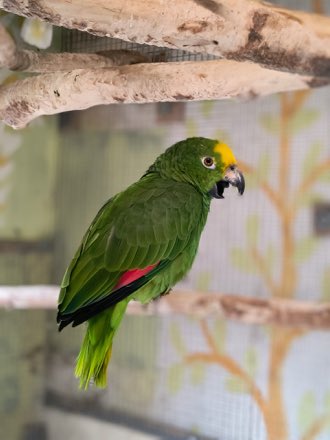
Nami
Yellow-crowned amazon (Surinam subspecies) Amazona ochrocephala ochrocephala
Looking for an adoptive parent- Born
- 2021
- In care since
- 2023
- Location
- Luka pod Medníkem
We have not written down a story yet.

Suri
Yellow-crowned amazon (Surinam subspecies) Amazona ochrocephala ochrocephala
Looking for an adoptive parent- Born
- 2021
- In care since
- 2023
- Location
- Luka pod Medníkem
We have not written down a story yet.
Other parrots 35
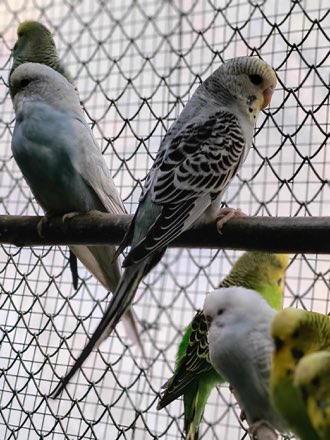
Barunka
Budgerigar Melopsittacus undulatus
Looking for an adoptive parent- Born
- 2019
- In care since
- 2023
- Location
- Luka pod Medníkem
We have not written down a story yet.
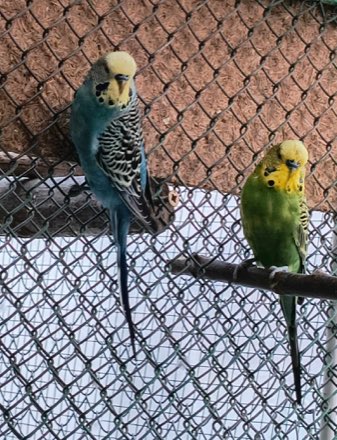
Bret a Tomička
Budgerigar Melopsittacus undulatus
Looking for an adoptive parent- Born
- 2022
- In care since
- 2023
- Location
- Luka pod Medníkem
We have not written down a story yet.

Čtyřlístek a Sedmikráska
Budgerigar Melopsittacus undulatus
Looking for an adoptive parentWe have not written down a story yet.

Sedmikráska a Čtyřlístek
Budgerigar Melopsittacus undulatus
Looking for an adoptive parent- Born
- 2023
- In care since
- 2023
- Location
- Luka pod Medníkem
Read the story
The story of a woman who rescued the budgerigar Čtyřlístek.

Kiki
Cockatiel Nymphicus hollandicus
Looking for an adoptive parent- Born
- 2021
- In care since
- 2021
- Location
- Luka pod Medníkem
We have not written down a story yet.
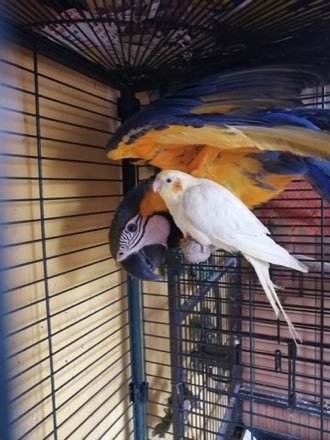
Tany
Cockatiel Nymphicus hollandicus
1 adoptive parent- Born
- 2019
- In care since
- 2019
- Location
- Luka pod Medníkem
Read the story
The cockatiel was brought in by breeders whose breeding pair had flown away, leaving three underfed, starving chicks in the nest box. Little Tany was very weak and it took a long time before he was weaned. He was placed in the incubator with the little blue-and-yellow macaw Chaco. Sharing the space did both the cockatiel and the little macaw good. For a while they were brothers. The macaw Chaco grew much faster, but that did not bother them. They slept snuggled into each other — the cockatiel always fitted himself under the little macaw's wing. And that is how they rested later in the aviary too. It was a comical sight when a large macaw sat on a branch with only the tip of a cockatiel's tail peeking out from under his wing. They lived together for several months, then Chaco began joining the other macaws, and there it was already dangerous for the tiny cockatiel. Both parrots came into the world during dramatic days, when a vast fire was raging in South America and destroyed large parts of the rainforest. Laguna put together a project to help the burning part of the southern Pantanal in the Chaco. That is where the macaw got the name CHACO and the cockatiel the name PANTANAL, shortened to TANAL, and so TANY.
My adoptive parents Bažantová Lucie (since 4/2021)

Ferdík
Eclectus parrot Eclectus roratus
1 adoptive parent- In care since
- 2023
- Location
- Luka pod Medníkem
Read the story
Ferdík came to us together with Kryštůfek. The owners rescued both boys from some cellar, out of dreadful conditions. At one unqualified veterinary practice he was diagnosed with diabetes in the past and treated for it as well, but he never had it. He plucked for a long time, which has left his follicles damaged and his feathers do not grow back.
My adoptive parents Vosková Daniela (since 6/2025)
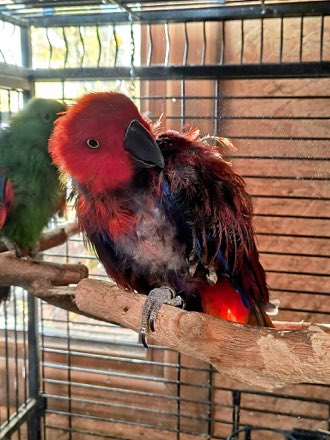
Heda
Eclectus parrot Eclectus roratus
Looking for an adoptive parent- In care since
- 2022
- Location
- Luka pod Medníkem
Read the story
Heda and Ruda came together from Plasy Zoo, where they were not thriving much, had health problems and had also started plucking. They now live together as a pair, their health is fine, but a little plucking still persists.
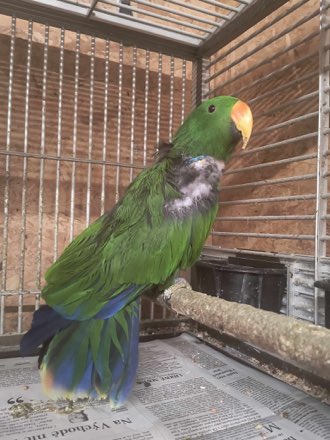
Kryštůfek
Eclectus parrot Eclectus roratus
Looking for an adoptive parent- In care since
- 2023
- Location
- Luka pod Medníkem
Read the story
Kryštůfek came together with the other eclectus, Ferdík. The owners freed them from some cellar, where they had been living in dreadful conditions. Kryštůfek had evidently suffered some eye disease earlier and went blind. He has his own cage, where he finds his way around well.
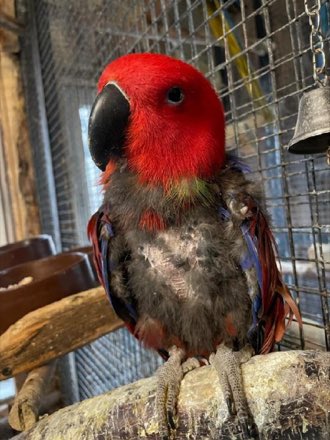
Mandy
Eclectus parrot Eclectus roratus
1 adoptive parent- Born
- 2012
- In care since
- 2023
- Location
- Luka pod Medníkem
Read the story
Mandy lived with an elderly woman as her companion. She was very spoiled and so her feeding was not ideal either. The owner's advanced age no longer allowed her to go on looking after Mandy, and so the owner's daughter brought the parrot to Laguna. Mandy has health problems and suffered for a long time from chronic inflammation in her leg, which was eventually cured.
My adoptive parents Holíková Petra (since 3/2023)
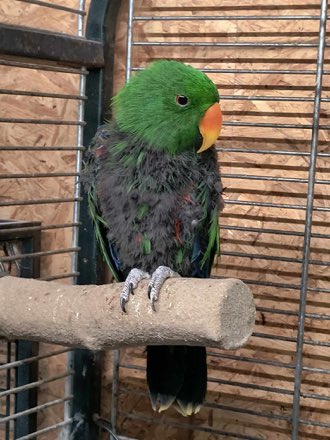
Myšák
Eclectus parrot Eclectus roratus
Looking for an adoptive parent- Born
- 2019
- In care since
- 2023
- Location
- Luka pod Medníkem
We have not written down a story yet.
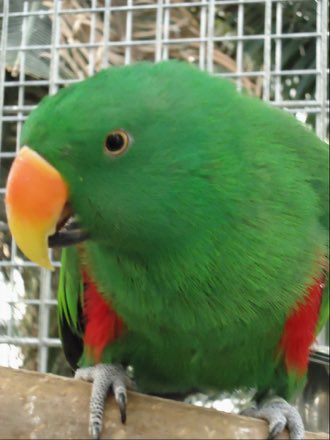 15 years in care
Oskar
Eclectus parrot Eclectus roratus
1 adoptive parent- Born
- 2001
- In care since
- 2011
- Location
- Luka pod Medníkem
We have not written down a story yet.
My adoptive parents Dokoupilová Naďa (since 12/2020)
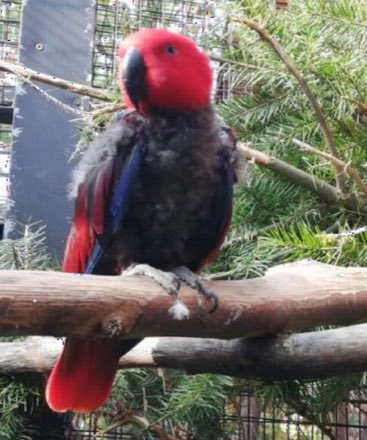
Rozárka
Eclectus parrot Eclectus roratus
2 adoptive parents- Born
- 2000
- In care since
- 2020
- Location
- Luka pod Medníkem
Read the story
Rozárka comes from a breeder in Plzeň who could not go on looking after her. With us she fell in love with the handsome male Oskar, lives with him as a pair, and Oskar looks after her like a true knight.
My adoptive parents Jarcová Kristýna (since 8/2021), Blechová Jana (since 7/2022)
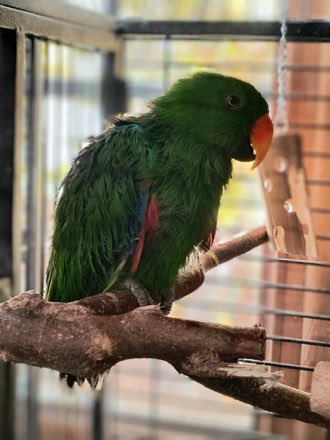
Ruda
Eclectus parrot Eclectus roratus
Looking for an adoptive parent- In care since
- 2022
- Location
- Luka pod Medníkem
Read the story
Heda and Ruda came together from Plasy Zoo, where they were not thriving much, had health problems and had also started plucking. They now live together as a pair, their health is fine, but a little plucking still persists.
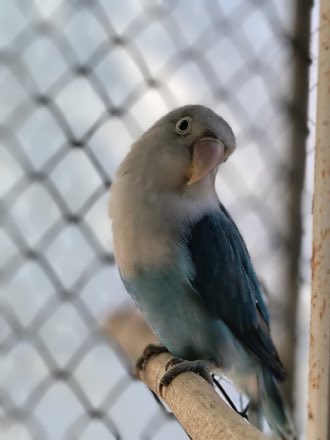
Oušn
Fischer's lovebird Agapornis fischeri
1 adoptive parent- Born
- 2019
- In care since
- 2023
- Location
- Luka pod Medníkem
Read the story
Oušn lived contentedly with his female, just as it should be. Everything collapsed when his beloved mate died. Oušn was immensely desperate and within a week he had a stroke. He ended up in several weeks of treatment at the vet's. A little appetite for life was given back to him by another lovebird who was there as a long-term inpatient. When his mate went home, we recommended a new female to the owner. She refused, however, and no longer wanted Oušn. Even though Oušn was still on supportive medication, it was necessary to act fast, as the loneliness was crushing him. He went to Laguna to finish his treatment, because there is a small flock of lovebirds here. And it worked — one female chose Oušn and we moved her into his cage. Oušn needed a partner who would give him a spark of life. After a few weeks he had recovered so well that he and his new mate joined the flock. We named his friend Šance, “chance”, because she was Oušn's chance at a new life. And it worked: Oušn not only has his mate, but lives in a small flock of other lovebirds. And that is how it should be.
My adoptive parents Havlíčková Zdenka (since 1/2026)
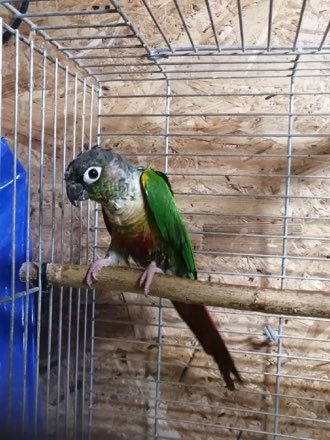
Bůčo
Green-cheeked parakeet Pyrrhura molinae
2 adoptive parents- Born
- 2021
- In care since
- 2022
- Location
- Luka pod Medníkem
Read the story
His last owner rescued the roughly one-year-old conure from unsuitable conditions. The young conure had been outdoors in an aviary all year round. He was already tearing out his feathers there. He was fed mainly on sunflower seeds. He had evidently had bad experiences with people, because he plucked a great deal. The new owner took the conure home with her, started feeding him a seed mix for conures and he got fresh fruit and vegetables. But he was very afraid of people and of everything. His condition did not improve and he preferred to stay tucked away in the nest box all day. After two months the owner gave up and brought him to Laguna, so that he could make friends here and take his mind off things. Little Bůčo arrived completely plucked and frightened. He spent most of the summer in the outdoor aviary with two other conures. And before autumn came, the plucked little wretch emerged as a beautiful, fully feathered parrot. You can see that the friendship of other conures did him good.
My adoptive parents Vránek Ondřej (since 2/2023), Bažantová Lucie

Hačiko
Green-cheeked parakeet Pyrrhura molinae
Looking for an adoptive parent- Born
- 2022
- In care since
- 2022
- Location
- Luka pod Medníkem
Read the story
The owner got the young conures as her pet friends. First the tiny Hačiko (a yellow-bellied conure) came into the household. She had been hand-reared. Shortly after three weeks her friend Nory (a green-cheeked conure), reared by her parents, joined her. From the start both conures were kept loose in the house. They only went into the small aviary to eat. The woman gave them a lot of attention and trained them to a TARGET pointer. She played with them and taught them various tricks; they liked more complicated toys. But then a problem arose with the cats living in the house, which started attacking the conures a great deal. She could no longer let them out freely; the cats attacked even the cage. There was a direct danger that something would go wrong. So the owner preferred to take both conures to Laguna, to protect them from the feline predators. There are already more conures here, so in time it may be possible to make friends of them all and put them in a shared play aviary. Conures are, after all, immensely playful and cheerful creatures.
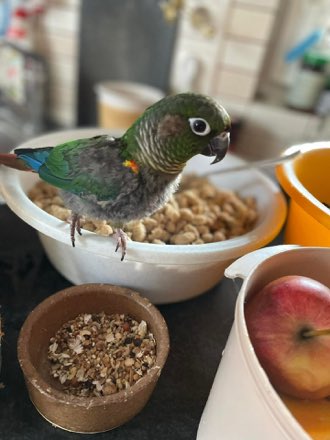
Kuky
Green-cheeked parakeet Pyrrhura molinae
Looking for an adoptive parent- Born
- unknown
- In care since
- 2022
- Location
- Luka pod Medníkem
Read the story
Hello, my name is Kuký and I came into the family on purpose. I was a birthday present from my owner to her boyfriend at the time (who, thank goodness, left a month later). He did not look after me at all and wanted me to be able to do everything at once, and this is what he supposedly wished for. And so I was left alone with my owner. Every day when she came home from work she opened my cage door, and right up to the moment she went to bed I was outside with her, on her shoulder, in the kitchen while she cooked; I helped her tidy up (of course I also made her more work in the form of droppings). I also liked dancing when someone tapped their nails on the table:). I wanted to be with my owner all the time. Every time I was shut in for a long while I started plucking, so that my owner would notice something was wrong and would have me with her again and kiss my little head. But after not quite two years she found a mate of her own kind and I did not like that much. I started plucking even more, even though she still let me out. Once it went so far that I chewed off my flight feathers and tail so badly that I could not fly until my next moult. So my owner drilled a curtain rail onto the wall right next to the sofa. I could get to her — on foot. I really did not like her mate, even though he tried hard to give me attention. Then suddenly he was gone again and I had my owner to myself. It was not long, though, before another mate came along. He gave me attention as though I were his own, brought me treats, played with me, but despite all that I tried to drive him away from me from time to time. A few months went by and my owner brought home a small screaming bundle around which the whole world began to turn. Even so my owner tried to give me attention, but it was not the same any more. In time I started being nasty to her as well. When the bundle screamed, I screamed too, and my owner was miserable about it. When she changed my food or water bowls, I gave her a good nipping. I nipped her when she wanted to take me out of the cage, or put me back in it. I wanted to let her know that I was there too, so that she would notice me the way she used to. But the more I bit her, the more I was shut in the cage as punishment. I did not understand it. When the little bundle grew up a bit and stopped screaming so much, my owner started letting me out more again; even though I nipped her, I was outside all the time and kept an eye on that walking bundle. Even though my owner tried to make friends of us, I tasted the bundle's finger several times. But I did not nip him. My owner was fussing around him more and more than around me, and so I bit the bundle harder, until he started screaming again. My owner did not like that and I was shut in again, mostly. My owner was miserable and cried all the time, and one day she told me she would take me somewhere called Laguna and that I would be well off there, that I would have lots of friends of my own there and plenty of human ones too. That they would look after me well. That I could not be this nasty to everyone at home. And so here I am with you. I am still a bit afraid of you, there are lots of new sounds here, new faces, but I think I will be fine here. I have even been given my own personal friend, with whom I now share a home; he seems nice, but we have plenty of time to get to know each other 🙂 after all, I turn 6 this year and I will be here with you for many years yet 🙂

Nory
Green-cheeked parakeet Pyrrhura molinae
Looking for an adoptive parent- Born
- 2022
- In care since
- 2022
- Location
- Luka pod Medníkem
Read the story
The owner got the young conures as her pet friends. First the tiny Hačiko (a yellow-bellied conure) came into the household. She had been hand-reared. Shortly after three weeks her friend Nory (a green-cheeked conure), reared by her parents, joined her. From the start both conures were kept loose in the house. They only went into the small aviary to eat. The woman gave them a lot of attention and trained them to a TARGET pointer. She played with them and taught them various tricks; they liked more complicated toys. But then a problem arose with the cats living in the house, which started attacking the conures a great deal. She could no longer let them out freely; the cats attacked even the cage. There was a direct danger that something would go wrong. So the owner preferred to take both conures to Laguna, to protect them from the feline predators. There are already more conures here, so in time it may be possible to make friends of them all and put them in a shared play aviary. Conures are, after all, immensely playful and cheerful creatures.

Pyry
Green-cheeked parakeet Pyrrhura molinae
1 adoptive parent- Born
- 2021
- In care since
- 2021
- Location
- Luka pod Medníkem
Read the story
Pyry hatched in the nest box as the fifth chick. The parents looked after the first three chicks exemplarily; the fourth chick sadly died. The fifth chick — our Pyry — was a good deal smaller than the others. The parents were already feeding the bigger chicks coarser food, and they fed tiny Pyry the same way. But she could not yet digest the small seeds. Her crop became blocked, the food soured, mucus formed and digestion stopped. Bacteria immediately began to multiply. The parents tried to get the tiny chick moving, and in their carelessness injured her head. We had to clean out little Pyry's crop, start her on antibiotics and then begin feeding her all over again — light mash and into the incubator. Her digestion was still faltering for a whole week, but in the end everything settled and the little one began to thrive. Today she is a beautiful, healthy conure.
My adoptive parents Siudová Lenka (2026)

Pepík
Monk parakeet Myiopsitta monachus
2 adoptive parents- Born
- 2020
- In care since
- 2022
- Location
- With a foster carer
Read the story
The monk parakeet Pepíček was acquired as a friend for the roughly nine-year-old Senegal parrot Vlastík. They lived together for about two years in a house in Moravia. The monk parakeet Pepíček settled in very quickly and took a liking to the Senegal parrot. In fact he insisted on his ownership rights over him and would no longer lend the tame Vlastík to the owner. But then the owners divorced. Although the parrots had originally been bought for the husband, he was not interested in looking after them, and so all the care was arranged by the woman, who did it gladly. After the divorce the woman took the parrots over and moved with them into a small flat. She tried to provide them with all the care they needed, including letting them out around the flat every day. Except that she also had two cats and a chihuahua. So the animals had to take turns for their free walks around the flat. In the end she decided it was better to place the parrot boys at Laguna, because the cats were constantly lying in wait for a chance to catch one of them, so she chose to head off the accident that was looming. At Laguna they each have the chance to join their own parrot group. For a start they are together, because so far there has been no female for the monk parakeet Pepíček, so that he would not be alone. We have to wait until some princess is found for him.
My adoptive parents Skalská Vladimíra (since 1/2025), Šulcová Martina (since 1/2025)
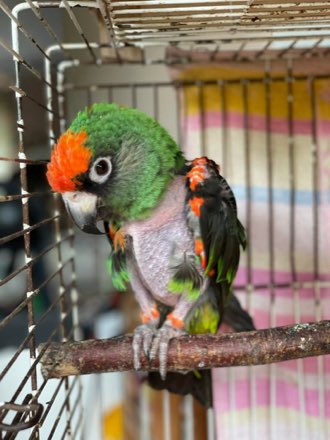
Pepíček
Red-fronted parrot Poicephalus gulielmi
3 adoptive parents- Born
- 2007
- In care since
- 2021
- Location
- Luka pod Medníkem
Read the story
The parrot lived for 12 years with the nephew of his last owner. When an allergy showed up in the boy after some years, they placed Pepíček with his elderly aunt. The woman looked after him for two years. Pepíček never became friends with her, he attacked her a good deal and feeding him was a problem. For a long time the parrot had been fed grain that was too fatty, and this led to fatty degeneration and damage to his liver. Pepíček started plucking, until only smooth skin was left on his belly. When the woman had an accident and was left on crutches, a serious problem arose. Despite her health complications the woman tried to go on looking after Pepíček, but he kept going for her, until he gave her a nasty wound on the hand that took a long time to heal. It was clear that Pepíček could not stay with her. But nobody wanted a plucked parrot. In tears, the woman took the parrot to the vet's to have him put to sleep, since there was no place for him in the world. Fortunately the vet knew Laguna and, instead of euthanasia, called us and arranged his placement. The happy woman took Pepíček and drove straight from the surgery to Laguna, where the parrot found a new home. At the beginning things were not at all easy with him, because of his state of health. Because of the unsuitable diet and the stress that followed, his liver was badly damaged and his kidneys do not work as they should either. He was put on a targeted diet and is kept under constant supervision. When his condition worsens he is given supportive medication. Hopefully his health will stabilise and he will be here with us for a long time yet. Otherwise he is a cheerful chap full of energy.
My adoptive parents Hornofová Lucie (since 7/2022), Englerová Kateřina (since 12/2024), Prosman Jiří (since 2025)
Agáta
Rose-ringed parakeet Psittacula krameri
Looking for an adoptive parent- Born
- unknown
- In care since
- 29 September 2021
- Location
- Luka pod Medníkem
Read the story
We do not know this parrot's history. A woman found her in a bush in the spring of 2021. She was on her way to a wedding and, during a stop, discovered a wrecked, bedraggled yellow budgerigar in a bush. As it happened, the day before she and her family had been clearing out a barn and the woman had an old cage in the car, destined for the rubbish. She put the parrot in it and carried on to the wedding she had planned to attend. In the end the yellow budgerigar turned out to be a rose-ringed parakeet — a yellow mutation. She was given the name Agáta. The woman put up leaflets and announced the parrot on social media, but no owner was found. Agáta recovered and her torn-out feathers grew back. But the small cage did not suit her; she kept getting startled and breaking off her newly grown tail feathers. The woman decided to bring Agáta to Laguna. After quarantine she was put into the outdoor aviary with a group of mostly Australian parrots. Here she can fly and get her condition back. At the moment she is friends with a monk parakeet.

Ella
Senegal parrot Poicephalus senegalus
3 adoptive parents- Born
- 2008
- In care since
- 2019
- Location
- Luka pod Medníkem
Read the story
My owner and I moved from a house into a new flat and I did not like it there at all, so I screamed as hard as I could. The neighbours were sooo thrilled about how good I am at it. I like it at Laguna, because I can talk with the other parrots, who understand me. But what I like most of all is my new friend Rio; he is a handsome one.
My adoptive parents Lenc Ondřej, Lencová Nikola, Růžička Tomáš
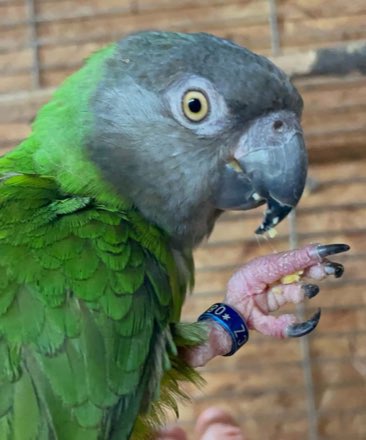
Komínek
Senegal parrot Poicephalus senegalus
Looking for an adoptive parent- Born
- unknown
- In care since
- December 2025
- Location
- Luka pod Medníkem
Read the story
For the second day running, scrabbling and cheeping was coming from the ventilation shaft of a Prague flat. After unscrewing the cover, the owners glimpsed a few feathers at the back; it was clear that some bird had fallen down the chimney from the roof. The man called in from the City of Prague Rescue Station could not help either, and the unknown bird stayed in the shaft. There was nothing for it but to tempt the little bird out with food and wait. What a surprise when a Senegal parrot suddenly appeared on the shower cubicle. He willingly stepped onto a hand, shaking, but he ate and drank straight away. A search for the owner began, but nobody came forward to claim the lost parrot. In the meantime the parrot was taken to Laguna. But the drama only began here. The parrot was given the working name Komínek, “little chimney”. Over those two days in the ventilation shaft he had pecked at whatever he found and had evidently been partly poisoned by the fumes. His liver and kidneys began to fail and Komínek just lay there, not eating, preparing to die. The fight for his life played out between Christmas and New Year, when he lay in an incubator and was alive only thanks to daily infusions, feeding mash given by tube into his crop, and medication for his damaged liver and kidneys. Only in January did he begin to come round and cautiously try eating again. His recovery was very slow, but we were grateful for every small improvement. Only after two months did he get his own cage and start playing. Komínek is a very good-natured parrot, he lets himself be picked up and is grateful for every stroke.

Kubka
Senegal parrot Poicephalus senegalus
2 adoptive parents- Born
- 2005
- In care since
- 2020
- Location
- Luka pod Medníkem
Read the story
The smallest of the pets, Kubka the Senegal girl likes singing to herself whatever mood she is in.
My adoptive parents Růžička Tomáš (since 7/2020), Macková Veronika (since 1/2025)

Lori
Senegal parrot Poicephalus senegalus
Looking for an adoptive parentWe have not written down a story yet.
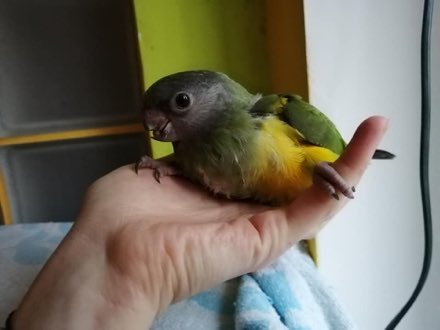
Petarda
Senegal parrot Poicephalus senegalus
Looking for an adoptive parent- Born
- 2019
- In care since
- 2019
- Location
- With a foster carer
Read the story
The brave Petarda was taken in with a serious injury to her beak when she was only a two-week-old chick. Little Petarda was looked after exemplarily by her parents, until the pre-Christmas celebrations arrived in the form of firecrackers. The parents took fright and, stressed, bit off the chick's upper beak while feeding her. The chick was treated and had to be fed artificially, for a very long time. After the unfortunate event the little one came to be called Petarda, “firecracker”, and that stayed with her in the end. She is a great fighter: she survived a long time on artificial feeding and then began cracking her first seeds by herself, bit by bit. Today she is an independent, cheerful girl, even though her beak is still growing back and the lower part needs adjusting too. But it is already certain she will manage.
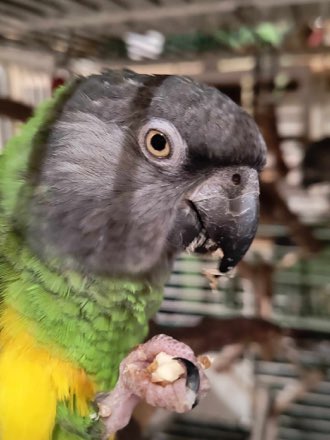
Pipi
Senegal parrot Poicephalus senegalus
Looking for an adoptive parent- In care since
- 2022
We have not written down a story yet.
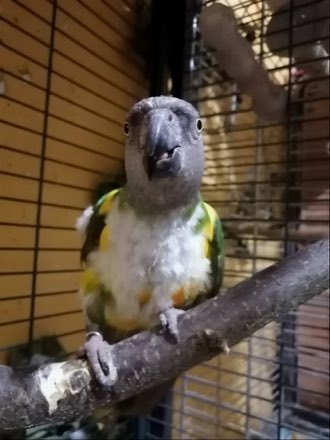
Rio
Senegal parrot Poicephalus senegalus
Looking for an adoptive parent- Born
- 2013
- In care since
- 2019
- Location
- Luka pod Medníkem
We have not written down a story yet.
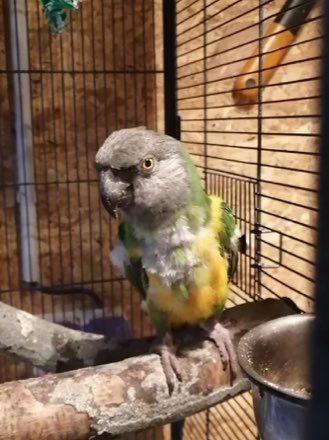
Rozárka
Senegal parrot Poicephalus senegalus
Looking for an adoptive parent- Born
- 2012
- In care since
- 2022
- Location
- Luka pod Medníkem
Read the story
Rozárka is already the 7th Senegal parrot at Laguna, if I do not count the two (Jaroušek and Petarda) placed in foster care. She is a bit of a nomad. She is about 10 years old and has already been through 4 owners, so Laguna is the fifth. She was always kept on her own as a pet. Only once did she have an amazon in the neighbourhood. In two households she coped with cats as well. She is affectionate, but she knows how to put things in order. Her last owners felt that she was unhappy on her own and needed company. And on top of that a baby was due in the family and further complications could arise.
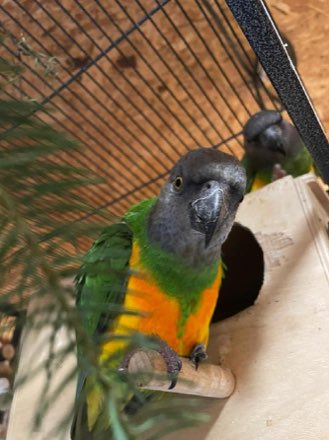
Vlastík
Senegal parrot Poicephalus senegalus
1 adoptive parent- Born
- 2011
- In care since
- 2022
- Location
- Luka pod Medníkem
Read the story
The owner bought the parrot out from a backyard breeder in Liberec as a present for her husband. They named him Vlastík and spoiled him nicely. He was fed a mix for African parrots; of fruit he liked blueberries, raspberries and the core of a pepper best, but essentially he ate all seasonal fruit and vegetables. As a reward he got a piece of sponge biscuit. The woman tamed him nicely, he would step onto her finger and they had lovely chats. Later a friend joined Vlastík — the monk parakeet Pepíček. The two parrots became great friends. Actually the livelier monk parakeet Pepíček claimed the Senegal parrot Vlastík for himself and would not lend him to the woman any more. They lived nicely in a little house in Moravia. The husband did not look after the parrots, but the woman gave them a lot of attention and cared for them lovingly. Then something went wrong between the people and the couple divorced. Because their owner was not interested in them, the woman took them over into a small flat. She looked after them as best she could and let them out to fly around the flat every day. But she also had two cats and a chihuahua there, so the animals had to be let out in turns. The cats lay in wait for the parrots a good deal, so the woman decided it was better to place both parrot boys at Laguna before any accident happened. The parrots are together for now. We do have a female for the Senegal parrot Vlastík, but then the monk parakeet Pepíček would be left alone. Once we have some princess for Pepíček, we will try offering them both their girls.
My adoptive parents Mikulandrová Michaela (since 8/2022)
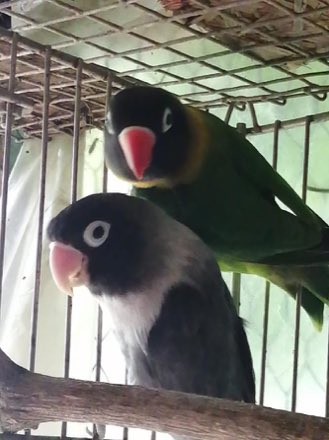
Basim a Greyka
Yellow-collared lovebird Agapornis personatus
Looking for an adoptive parent- Born
- 2019
- In care since
- 2022
- Location
- Luka pod Medníkem
Read the story
Both lovebirds were bought at a Zverimex shop. Nobody wanted to buy the grey female, saying she was not interesting in colour, but the woman fell in love with her at once and thought her the most beautiful of them all. And she bought a male to go with her, so that she would not be alone. The two little birds fell in love with each other and the woman looked after them exemplarily. Over a few years they reared several chicks. Lately, however, the owner began to have health problems and could no longer look after them properly, and so she decided to give the parrots up. She did not want to sell them off into the unknown, so she brought them to Laguna, to be sure that they would stay together and at the same time to be able to keep track of them and visit them now and then. So let us hope they will like it with us just as much as they did with their owner.
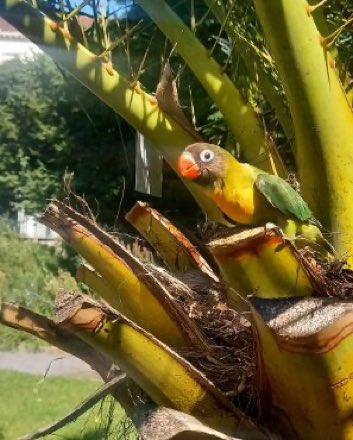
Bibi
Yellow-collared lovebird Agapornis personatus
Looking for an adoptive parent- Born
- 2023
- In care since
- 2023
- Location
- Luka pod Medníkem
Read the story
Bibi's parents threw her out of the nest box they were nesting in when she was a tiny bird. A keeper discovered Bibi while feeding, moved her into the warmth straight away and fed her. The parents would not have taken little Bibi back, and so we hand-reared her. After several months Bibi was ready to be released into the lovebird flock, which she joined beautifully.

Šance
Yellow-collared lovebird Agapornis personatus
Looking for an adoptive parent- Born
- 2023
- In care since
- 2023
- Location
- Luka pod Medníkem
We have not written down a story yet.
Small cats 4

Jerry
Caracal Caracal caracal
Looking for an adoptive parent- Born
- 2020
- In care since
- 2021
- Location
- Luka pod Medníkem
Read the story
A little caracal's story, Part 1 — How I came into the world and almost got lost from it again. Hello people and my feathered friends — I am Jerry the caracal. I am a beautiful medium-sized cat. I look a bit like a small puma with gorgeous pointed ears tipped with tufts, like a lynx has. I come from Africa. Well, not me any more — it was my great-grandmother who roamed freely across the savannahs there. My story began when I first peeked out at the world. I was born on 1 December 2020 to a caracal mother, along with one brother. We grew up in the home of our breeder, with our mother. But in the sixth week of my life came a change. A Mrs Cruella de Vil came for me, an unknown person who badly wanted me to be her pet. Well, ugh, you simply do not do that, taking such a baby from its mother. I was still tiny, but I am a brave cat after all, so I will manage. I lived in a big house completely loose with my cat friends, whom I chased up and down the stairs. The new owner thought I was already a big boy, so she fed me only twice a day with a bowl of meat and I got no milk at all. I thought too that I did not need it, since my older cat friends did not get any. In time I did not want to play so much any more, my energy was leaving me and my little legs stopped obeying me. At two months of age my big troubles began. I felt weaker and weaker, my legs hurt and I was even stopping being able to run. But a bigger problem came on the day I had my first seizure. My head decided that something was missing and went into spasm. And with it my body and my mind. I could not control myself at all. Imagine that in one moment you stop perceiving the world around you completely, your body is going through a constant earthquake and your brain feels as though it were plugged into an electric current. You have only one wish: for that mad torment to stop, so that you can breathe normally and fall asleep in peace. Sadly this state repeated several times in a row, and then you really do want it all to end. My great weakness led to me breaking my leg and stopping walking. When the lady of the big house found that things were getting worse and worse with me, and during one short while — endlessly long for me — saw my unrelenting spasms, she decided to take me to the vet, to the doctor, so that he could help me. I had no idea that on that day everything was only beginning. My weak body and aching legs just lay there. I let them do absolutely anything with me, I had no strength to resist like a proper little cat. The doctor took my blood to find out everything that was wrong with me. He did further tests, which came out catastrophically. Because as a growing kitten I had been getting no milk and only meat, I had lost almost all the calcium in my body. My bones had thinned, which is why I had broken my leg. The imbalance of calcium and phosphorus led to the seizures, which damaged the nerves in my brain every time they came on. The doctor gave me the first medicines to relieve me and tried to feed me milk. I did not much want it, but in the end I drank it after all and fell resignedly asleep. Even though I was asleep, I was aware of the doctor arguing with Mrs de Vil about what would happen to me next. The doctor wanted to keep me with him for treatment, so that he could step in if I had another seizure. The lady was not keen, but in the end she agreed to just a few days and left me in the doctor's care. Except that this is not the end of it, but the beginning. As a consequence of the unbalanced diet and the lack of calcium, further complications were piling up. That same day a keeper collected me from the doctor's at the vet's; with her gentle hands she lifted me lightly out of the box, pressed me to her chest and whispered quietly: “Don't be afraid, little big-ears, it will be all right now.” At that moment I knew that she would look after me and give me everything I needed. I felt calm and safe inside. I went off to a new, for now probably temporary home, which is called Laguna. They say it is a miraculous place where odd feathered winged things are rescued, ones that are either ill or that somebody did not want or could not keep at home. At Laguna live keepers who took me in among their own with loving arms, even though I have no feathers at all and am instead a furry little ball. I started being fed milk again, and various kinds of meat. After a few days of stabilising, they took me back to the vet's for further tests and X-rays. The X-ray confirmed my fracture in the right leg, in the growth zone at the knee, because of which I did not want to and could not walk. I was given a strange sort of little tube into my front leg, so that I would get calcium straight into the vein, because I really did have far too little of it. Given the poor state of my bones and the fracture, my condition needed to be assessed by a special orthopaedic doctor, which was a big problem: Mrs de Vil wanted me back in the big house. Before it could all be agreed and arranged, I broke two more parts of bone, because the first fracture I already had began to knit crookedly, and the tilt of my centre of gravity and the rotation of the leg went differently from how they should. When the lady of the big house finally agreed, an appointment with the orthopaedic doctor could be arranged. So that he could examine me properly, I had to have an empty stomach because of a short general anaesthetic. For me that meant no meat and milk for half a day; I was last allowed to eat in the morning. I no longer even had the tube in my leg, because I had pulled it out while playing and they did not put it back. It was thought that the calcium had got into my blood a little already and that it would be fine. During this planning, something complicated was going on at the other end, between my rescuers and Mrs Cruella. She wanted me back in the big house at any cost. She did not want another doctor examining me and did not want me to stay in my doctor's care any longer. Except that caring for me was very demanding. I could not get to the toilet by myself, my broken legs would not hold me. So the keepers helped me and put nappies under me for every time I relieved myself, and always washed me thoroughly. They fed me several times a day straight into my little mouth, so that I could lie quietly and move as little as possible. The day of the check-up with the orthopaedic doctor came. I got a jab in the muscle and started falling asleep. While I slept they took further X-rays, which confirmed that I had two more fractures. Not only the one in the knee, but in both thigh bones as well, again in the growth zone. The doctor assessed my condition as very serious. An operation is possible, but with a 30 per cent chance of success. The thing is, my thinned bones can take nothing and are so weak that they may go on cracking. After the examination I began to come round from the anaesthetic. And there was a problem. That dreadful state of anxious spasms was coming over me again — the trembling, the dilated pupils, the current of electric lightning into my head and total loss of control over my body. Fortunately my keeper held me firmly and the doctor quickly put in a cannula and gave me sedatives, calcium and glucose. I began to feel relief at once. But I was utterly exhausted by it. I waited there a while and was given liquid nutrition through that strange tube in my paw, so that I would feel better. Then my broken bones were discussed again. An operation was necessary, but very risky. My rescuers and my personal doctor were very sad about it. They are trying to help me, but my devastated body is not cooperating. We all felt helpless. My Mrs de Vil had to be called so that she would be informed of my state of health, and that I was definitely in no state to return to the big house. The doctor tried to explain everything to Cruella. It was probably a very difficult conversation; by now it was about my life. In the end the lady agreed that the operation would be scheduled. Until then I would stay at Laguna, so that they could prepare me for the operation and watch over me so that I would not have another seizure. But the next day my lady's decision changed. After consultations with other doctors, who incidentally had never seen me and had only seen my X-rays, they concluded that my condition was so serious that it was not worth spending a lot of money on an operation that might not succeed. What does that mean for me? I do not really know myself, but I sensed from my keepers and my doctor that it was not good at all. The word euthanasia kept coming up, it went on with arguments, a ringing telephone, and was followed by my keeper crying. I understood nothing, but I was still determined to fight. A day passed and the orthopaedic doctor rang with an offer of a date for the operation. It was agreed and I still had some days to prepare. I had to gather enough strength and above all top up my calcium. You would not believe how important calcium like that is for life. While I rested and gathered strength, the fight between my rescuers and Cruella de Vil was still going on. She refused the operation; unhappy and tearful, she wanted to end my suffering. She wanted to take me away, but she knew that if she decided to do that, I would really leave this world. At the same time she wanted to give me a chance, but did not believe I would manage it. After a hard fight for my life, the doctor wrote a report and gave the lady a choice of three options: first — consent to the operation and post-operative care; second — a waiver, that is, a record of refusal of veterinary services; third — consent to euthanasia. It sounded terrifying and I was starting to be genuinely afraid of what would become of me in the end. I do not want to die, I am strong and I will manage it, really. Another day passed and Mrs de Vil did not state her decision, which was not at all an easy one. The date of the operation was approaching and still nobody knew how she would decide. In the end the doctor picked up the telephone and called her. A miracle happened: the lady wanted neither the waiver nor the euthanasia, and decided to give me up. The doctor had offered her a fourth option: if the lady signed a deed of gift and handed me into the doctor's care, he would write off her entire debt for my care, the operation on my broken bones would be carried out, but I would stay at Laguna with my doctor forever. The lady agreed. Two days were left until the operation. We waited for that miraculous signature with a stamp to arrive. Only one day was left until the operation and still nothing had come. We began to be afraid again, but in the end it came, it was there, in black and white. I no longer belong to Mrs Cruella de Vil from the big house, but to my doctor from angelic Laguna. Now I could prepare for the operation without any uncertainty at all. So, eat once more at midnight and then just wait until the afternoon for the orthopaedic doctor, who will work his magic.

Dino
Serval Leptailurus serval
Looking for an adoptive parent- Born
- 23 October 2023
- In care since
- 22 January 2024
- Location
- Luka pod Medníkem
Read the story
A little serval's fairy tale? — or a drama for the hard-hearted?! I am a little serval, Dinoušek. I am going to tell you the fairy tale of my life. They say fairy tales have a happy ending. And I want to believe that, even though my fairy tale has a bad beginning. I was born in the kingdom of Servalius to my young mother, as a twin; I had a brother. Sadly the happy beginning of my life ended after a few minutes, because my mother is not an experienced mother. She killed my brother during the birth and badly injured my right hind leg — she bit off a piece of my paw. And while babies are enjoying the first moments of their lives together with their mothers, I was off to the vet in a hurry, where I had to be put under, my injury treated and my leg stitched up. And then came the daily changing of dressings. My leg did heal a little, but I still had to keep it bandaged. I could not go back to my mother, so I was fed from a bottle of milk. Not even two months had passed when something strange happened… I was sold. At first I did not understand what was going on, but they shoved me into a transport case and squires carried me far, far away, over nine hills and nine rivers, until the case opened again and I found myself in a foreign kingdom — in the “Kingdom of the Black Gem”. Then I understood that the queen of the foreign kingdom had traded pearls and gems for me, so that I would bring her joy. Except I did not want to bring anyone joy, I wanted to go home, and on top of that my injured leg started to hurt. I am a young kitten, so I dash and jump about like mad. And my sick leg cannot cope with that. The growing stump of bone pressed against the thin skin and tore through it. And my leg kept bleeding a little and hurting. And since I was out of sorts, I bit my queen's subjects. And she began arguing with the sovereign that I was not the cuddly kitten he had promised and also that I had some problem with my leg. And you know how it is — when sovereigns argue, it takes forever and the common folk suffer. And here it was not the folk who suffered, but me. My leg hurt, I was furious, the queen was livid, but still nothing happened, they just kept arguing with the king of Emerald Servalia. A month passed, and when the armies of the Kingdom of the Black Gem and of the Kingdom of Emerald Servalia slowly began to line up and prepare for war, the queen of the Blue Bay appeared like a bolt from the sky, simply gathered me up just as I was — poor, injured and lost in a world of royal quarrelling — and took me under the protection of her army. I was lodged in the kingdom of the Blue Bay, where I had the full protection of the royal army. And intensive care began. I went through two operations. Sadly the period when I was not being treated had been too long, and an infection got into my leg that complicated the healing. Doctors from the surrounding kingdoms came to the kingdom of the Blue Bay. My future was very uncertain. Most of them proposed amputating the sick leg. But then I would not be able to jump and play. There were even proposals to end my life. I was beginning to fear it was all up with me. But my new friend, the caracal Jerry, reassured me that he had been far worse off and today lives like royalty. I tried to believe him. Almost every day I am treated and my leg is re-dressed. Now and then they load me up, take me for an X-ray, but I come straight back, so I am not even afraid any more. My leg is beginning to stabilise, only that infection in my body keeps causing trouble and I have to take lots of medicines. I have my own chamber, which adjoins the other servals, but they are too big and too wild. Several times a day I can run all over the royal castle, where I chase about with the caracal Jerry. But everyone watches me very closely. The thing is, I am a clumsy fool and keep attacking Jerry, as if we were going to play and wrestle. Apparently I am still too small for that; if Jerry knocked into me he could hurt me, I am still too fragile. And so I at least bite all the servants, to make it properly good fun. What is more, I have discovered that if I bite properly and unexpectedly, dark spots appear on my servants in that place. They are rather plain, so I nip them often, to make them as spotted as I am. I have been in the kingdom of the Blue Tide for several weeks now. I have grown a lot and got stronger. Only now and then I catch word from the men-at-arms that the two feuding kingdoms of Emerald Servalia and the Black Gem are still at war. But apparently I should not trouble myself with that; there are enough gold coins, pearls and gems in the coffers of the kingdom of the Blue Tide to pay the doctors for my medicines. And if they run low, many people of good heart live in the kingdom who will fill the healing coffer up again. I have no idea what will happen when the war between the two kingdoms ends; I am very afraid that foreign men-at-arms will turn up here and carry me off somewhere again. Only Jerry keeps reassuring me that I need not be afraid. Once I enter the kingdom of the Blue Bay, my ugly story will turn into the dream fairy tale I so wish for. And it came to pass just as the caracal Jerry said. I have stayed in the kingdom of the Blue Bay for good. But it was not easy. I lived safely in my dwelling, hearing only the distant rumble of armies and battles. Only Jerry reassured me: “Don't be afraid, the battle is harsh and long, but they will not give you up, I know how it goes. They will fight to the end so that you have your home here forever. The army of the kingdom of the Blue Bay will never give up. Believe me, I went through it too, it was wild, but it turned out well.” Author's note: the fairy tale has been reworked on the basis of real events. The names of the individual kingdoms are invented, but they symbolically capture the parties to the dispute — the battle for a happier life for the serval Dino. And that spotted fellow deserved it; he lived through a great many bad days.
Jenny
Serval Leptailurus serval
Looking for an adoptive parent- Born
- 2 May 2019
- In care since
- 18 September 2022
- Location
- Luka pod Medníkem
We have not written down a story yet.
Rosie
Serval Leptailurus serval
Looking for an adoptive parent- Location
- Luka pod Medníkem
We have not written down a story yet.
Big cats — Štít Zoopark 18
Lefinka
Barbary lion Panthera leo leo
Looking for an adoptive parent- Born
- 1 April 2016
We have not written down a story yet.
Sandy
Bengal tiger Panthera tigris tigris
Looking for an adoptive parent- Born
- 1 June 2016
We have not written down a story yet.

Antonius
Bengal tiger — white form Panthera tigris tigris
Looking for an adoptive parent- Born
- 19 August 2017
We have not written down a story yet.
Hector
Cougar Puma concolor
Looking for an adoptive parent- Born
- 4 September 2013
We have not written down a story yet.

Ella
Javan leopard Panthera pardus melas
Looking for an adoptive parent- Born
- 9 July 2017
We have not written down a story yet.
Baghíra
Leopard Panthera pardus
Looking for an adoptive parent- Born
- 30 October 2016
We have not written down a story yet.
Démon
Leopard Panthera pardus
Looking for an adoptive parent- Born
- 6 August 2017
We have not written down a story yet.
Jasmína
Leopard Panthera pardus
Looking for an adoptive parent- Born
- 6 August 2017
We have not written down a story yet.
Alma
Siberian tiger Panthera tigris altaica
Looking for an adoptive parent- Born
- 25 October 2018
We have not written down a story yet.
Ussuri
Siberian tiger Panthera tigris altaica
Looking for an adoptive parent- Born
- 25 October 2018
We have not written down a story yet.
Bastien
Transvaal lion Panthera leo krugeri
Looking for an adoptive parent- Born
- 1 July 2018
We have not written down a story yet.
Bella
Transvaal lion Panthera leo krugeri
Looking for an adoptive parent- Born
- 1 July 2018
We have not written down a story yet.
Freya
Transvaal lion Panthera leo krugeri
Looking for an adoptive parent- Born
- 1 July 2018
We have not written down a story yet.
Kiki
Transvaal lion Panthera leo krugeri
Looking for an adoptive parent- Born
- 20 August 2014
We have not written down a story yet.
Lima
Transvaal lion Panthera leo krugeri
Looking for an adoptive parent- Born
- 3 July 2020
We have not written down a story yet.

Marcelka
Transvaal lion Panthera leo krugeri
Looking for an adoptive parent- Born
- 19 August 2017
We have not written down a story yet.
Max
Transvaal lion Panthera leo krugeri
Looking for an adoptive parent- Born
- 9 May 2014
We have not written down a story yet.
Joy
Transvaal lion — white form Panthera leo krugeri
Looking for an adoptive parent- Born
- 30 December 2017
We have not written down a story yet.
Other animals 4
Jarmil
Burmese python Python bivittatus
Looking for an adoptive parent- Born
- unknown
- In care since
- 2026
Read the story
A Burmese python in the leucistic form joined our care, brought to the Vetexotic veterinary clinic by a foreigner. The snake was suffering from severe mouth rot, because of which he had lost his teeth and could not take food. The owner promised to collect him after a month of treatment. Sadly he never came back, and the contact details he gave are unreachable. The python, whom we named Jarmil, has meanwhile recovered beautifully. The inflammation was cured and today he can feed himself. Although he went through a hard time, he is unbelievably calm and good-natured, and gives the impression of being genuinely grateful for a second chance. We believe that with us Jarmil will have nothing but a contented and safe life from now on.
Bobo Ovečkin
Cameroon dwarf sheep Ovis aries
Looking for an adoptive parent- Born
- 19 May 2026
- In care since
- 21 May 2026
Read the story
The ewe did not accept the lamb when he was born and rejected him right after the birth. For the first two days the owners regularly supplemented his feeding with milked mother's milk, so that he would get everything he needed for a healthy start in life. Even so he took the switch to milk replacer badly, but thanks to a quick intervention by the vet his condition stabilised. He now gets a special milk replacer for lambs and is thriving very well. He was given the name Bobo and quickly won the hearts of everyone around him. He is very playful, inquisitive and likes nothing better than larking about with small children. Because he is growing up without a sheep mother, that role is being filled for now by people. He will stay at Laguna permanently and we believe he will become a popular member of our animal family.

Karel
Hermann's tortoise Testudo hermanni
Looking for an adoptive parentWe have not written down a story yet.
Kook
Laughing kookaburra Dacelo novaeguineae
Looking for an adoptive parent- Born
- 30 July 2022
- Location
- Luka pod Medníkem
Read the story
Do you happen to know who Kook is? You don't… I didn't know either. He is a chick of the laughing kookaburra, the largest kingfisher in the world. His homeland is Australia and there he is called a kookaburra. He is one of the few kingfisher species that do not hunt fish in water, but catch smaller vertebrates and insects on land — it is easier, and the kingfishers worked that out long ago. And how did this Australian end up at Laguna? Well, that is an old story. Years ago, when parrots had not yet occupied the premises of today's Laguna, a breeding pair of kookaburras lived here, among others. Now and then they reared chicks, who found homes with specialist breeders in the Czech Republic, and one boy settled in at Brno Zoo. Even when the breeding premises were then taken by storm by parrots in need, this pair enjoyed their well-earned retirement here. But this year the old folk somehow got carried away, laid eggs, and one of them was even fertilised (dad had been trying). Except they did not give the eggs much care, they broke them a little and did not sit on them much. So the fertilised one was patched up with varnish and off into the incubator with it. Although nobody gave it much hope, after three weeks little Kook hatched. Given the difficulties during incubation, the vet had to help him into the world a good deal, otherwise he would not have managed it on his own. And so it came about that on 30 July Kook was here, a small unfeathered something, and here he stayed. There was still some worry in the first days, when he did not much want to eat, but after that he grew like a weed. Well — you cannot imagine what that little piggy ate from an early age: mouse steaks. Really, they would beat out cutlets for him from breeding mice, and those were then dipped in some horrible stuff so that they would be pre-digested. And it suited him. Within a few weeks he grew into a handsome boy. Now and then he belts out that terrifying fanfare of his, and otherwise he just sits and stares, but he is one cool model. Incidentally, he practises that fanfare every morning around five o'clock, when the first train goes past. The roof tiles lift at that point, but here at Laguna nobody minds and everyone sleeps like a log. And that dietary speciality has stayed with him — for breakfast he gobbles down two mice. Really, the great brute. And in the evening too. But apparently that is how it should be.
No animal matches this search. Try another name, or clear the filters.
A project we support
ACPP — parrot conservation in Paraguay
Asociación para la Conservación de Psitácidos del Paraguay is a non-profit organisation protecting parrots in Paraguay. It was founded on 18 September 2024 in Hernandarias, out of a meeting of veterinarians and animal specialists.
One of its founding members is Dr Sebastian Franco, the veterinarian who also looks after our animals at VetExotic and who comes from that region. We have worked with the Urutau Chaco Animals centre in Paraguay since August 2019.
What ACPP works on
- rescuing parrots from the illegal trade and helping wild birds
- research into parrot biology, distribution and population status
- small conservation projects and public education nationwide
How to support ACPP
By a gift to Laguna's transparent account — the same one the Urutau Chaco Animals cooperation runs through. Just put ACPP in the payment message.
Earlier projects
Where we helped before
-
2013–2015
Little owls — breeding and return to the wild
From 2013 to 2015 we reared little owls every year, until our breeding male died. The young went to other rescue centres as breeding pairs, and some of them we released back into the wild together with AVES, z. s. Kladno.
The little owl is critically endangered here — its numbers have fallen by 60 % in thirty years and fewer than 100 pairs are thought to remain. In 2018 it was voted Bird of the Year.
-
2019
Urutau Chaco Animals, Paraguay
The Amazon forest fires crossed the borders of Brazil and Bolivia and spread through the southern Pantanal into Paraguay, where they destroyed more than 100,000 hectares of forest. Our veterinarian Dr Sebastian Franco, who comes from that region, was asked to come and help. Together with Biopark Štít, Laguna organised the mission Pantanal and Chaco in distress — we sent volunteers who, alongside local firefighters and the staff of the Urutau centre, searched the burnt ground, treated injured animals and carried them to the centre. People backed the mission with money and with supplies: medicines, veterinary equipment and protective gear for the firefighters.
In August 2025 the centre announced it can no longer take in animals — the cost of its present load is at the limit of what it can carry. Laguna’s work in Paraguay now continues through ACPP.
More about Urutau -
2020
Biopark Štít
Saving Biopark Štít through the covid period. Today's care for big cats grew out of that help — the eighteen big cats at Štít Zoopark are in the list above.
Where to find us
We take the parrots out to people
At these shows we are not putting animals on display as an attraction. We go so that people can get a feel for what a large parrot really involves — before they get one.
-
Praha, Albertov
Botanická zahrada Univerzity Karlovy
Exotic bird show
Our home show, held with the Club of Exotic Bird Friends in the second half of August every year. Our permanent exhibit is here, along with the outdoor flight aviary opened in 2016.
79th–87th edition, documented every year 2015–2026
-
Lysá nad Labem
Výstaviště Lysá nad Labem
EXOTIKA
The largest Czech exotic animal show, at the end of October. We bring the largest flock of cockatoos here, and since 2023 the cats as well — the serval and the caracal we raised from kittens.
documented 2015–2019 and 2021–2026
-
Praha
Přírodní park Hostivař
Parrot Lagoon summer gathering
An event we organise ourselves. A three-day gathering for the public and for breeders, free entry, with a specialist vet on site.
2026
-
Praha
PVA EXPO Letňany
For Pets
A trade fair for pet supplies. A place to talk with people who are still only considering a parrot — and to tell them what it involves.
2019, 2024
-
Krásné u Šumperka, Vysoká Peč u Chomutova, Pirátí zátoka v Praze, Rozkoš, Králíky
Srazy volně létajících papoušků
Parrot Days
A breeders' gathering where we bring an advice desk and where Magdaléna Žohová and Dr Sebastian Franco give talks. The proceeds often go to our animals.
documented 2017–2026
-
Klamoš u Chlumce nad Cidlinou
Biopark Štít
Walk-through aviary and weekend photo sessions
Since 2017, when we tried a walk-through aviary here with macaws, cockatoos, grey parrots and amazons. In 2020–2021 there were public photo sessions with the parrots here every Saturday.
2017, 2019–2021
Current dates are kept in our events calendar (in Czech).
Partners and supporters
We are not in this alone
-
Premises
Botanická zahrada Univerzity Karlovy
One of the centre's bases. The cockatoo aviary is here, and every year a joint exotic bird show.
-
Co-organiser
Klub přátel exotického ptactva
In 2015–2016 Laguna ran as a project under KPEP before becoming independent. We still organise the exotic bird show together to this day.
-
Research cooperation
Přírodovědecká fakulta Univerzity Karlovy
The Department of Zoology, led by Michal Vinkler, used our parrots to study why some of them suffer from behavioural disorders. The study on the loss of a key gene was published in Proceedings of the Royal Society.
-
Research cooperation
Česká zemědělská univerzita
Feather samples from our parrots served an international study of why parrots have such colourful plumage. Petr Maršík took part in it for the Czech University of Life Sciences.
-
Veterinary care
VetExotic
A specialist centre for birds, reptiles and zoo animals run by Dr Sebastian Franco, who is also Laguna's vice-chairman. The first professional care for every animal we take in comes from here.
-
Donor
Super zoo
At the start of 2019, e-shop customers could add a contribution for our parrots to their purchase. The collection raised CZK 73,750 and Super zoo handed it over on 11 April 2019; we bought food supplements, light bulbs and bedding with it.
-
Long-term cooperation
Biopark Štít
Help with food and veterinary care in the covid year of 2020. Today's care for big cats grew out of that cooperation.
-
Partner centre, Paraguay
Urutau Chaco Animals
Spolupráce od srpna 2019, kdy požáry zasáhly paraguayskou část Pantanalu. Stanice v srpnu 2025 oznámila, že už nemůže přijímat další zvířata.
-
Donor
Michal David
In April 2016 he ceremonially opened the outdoor aviary at the Botanical Garden. The report lists him among the biggest sponsors of the construction and quotes his gift of CZK 25,000 for further aviary equipment.
In the media
What has been written and broadcast about us
A selection of where we were noticed. The full list is in our Laguna in the media section (in Czech). The titles are given in the original Czech — they are the actual headlines.
- 2026 Rádio Junior Mezi námi zvířaty — získat si přízeň exotického ještěra trvá roky broadcast
- 2026 Český rozhlas střední Čechy Od zachráněných papoušků se o předchozích majitelích dozvím všechno interview
- 2025 Ararauna.cz Botanická zahrada hostí 86. výstavu exotů article
- 2024 Déčko, Česká televize Wifina — Záchranná stanice papoušků broadcast
- 2023 Český rozhlas střední Čechy Papoušek v nouzi ztrácí peří i chuť do života news report
- 2022 CNN Prima News Papoušci jako zábavní společníci, kterým samota nesvědčí news report
- 2022 Rádio Junior Chovatelka nezvládla péči a karakal skončil v záchranné stanici broadcast
- 2021 Generace 20 Záchranná stanice Laguna funguje jako babybox pro papoušky article
- 2021 Rodinné výlety Záchranná stanice, která pomáhá papouškům v nouzi article
- 2021 Rádio Junior Kakadu není ozdoba do bytu. Je žárlivý a vyžaduje péči broadcast
- 2020 CNN Prima News Chovatelé papoušků vzkazují senátorům: pták má křídla, aby létal news report
- 2020 Show Jana Krause Magdalena Žohová v talk show interview
- 2020 Český rozhlas Plus Natura — novela zákona míří proti cirkusům, bojí se i chovatelé broadcast
- 2020 Časopis Příroda Rozhovor s paraguayským veterinářem — číslo 1–2/2020 print interview
- 2019 Ararauna.cz Laguna organizuje záchranu zvířat v paraguayském Pantanalu article
- 2018 TV Nova V Praze můžete vidět exotické ptáky a přispět na dobrou věc news report
- 2018 Novinky.cz Černé labutě a mluvící loskutáci matou návštěvníky article
- 2017 Česká televize Hobby naší doby s Jiřinou Bohdalovou broadcast
- 2016 Ararauna.cz Venkovní voliéru slavnostně otevřel Michal David article
- 2015 Novinky.cz Opeření krasavci se předvádějí v pražské botanické zahradě article
Get in touch
Have a question about a particular animal, want to help in some way other than adoption, or are you facing a parrot you can no longer care for? Write or call.
- info@centrumlaguna.cz
- Phone
- +420 603 211 381
- Where to find us
- Luka pod Medníkem, 254 01, Czech Republic
Support the whole centre
You do not have to pick one animal. A one-off gift of any size helps wherever it is needed right now — including the animals that have no adoption page of their own.
Transparent bank account
2501164977/2010
Fio banka, a. s. (Czech Republic)
IBAN CZ16 2010 0000 0025 0116 4977
BIC FIOBCZPPXXX
Where the money goes
Food, veterinary care and running the aviaries. We receive no public subsidies. The largest share of our income comes from gifts and from the regular contributions to virtual adoptions, the rest from talks, public events and other activities.
View the account transactions